LAB Pro
A new economic strategy used by several cities and regions to create a more sustainable living environments is called the Doughnut Economics Model which is interlinked with UN Sustainable Development Goals. This article presents the results of an internship project conducted with Päijät-Häme Regional Council based on ClimateGO project and will compare and analyze the experience of cities and regions that have implemented this approach in their urban governance.
Authors: Razieh Rafiei & Eeva Aarrevaara
The Doughnut Economics Model: a novel economic mindset for the 21st Century
Kate Raworth developed a visual framework called the Doughnut Economics Model to question the traditional view of economics, which primarily depends on a nation’s GDP. According to this framework, we need to employ a new economic model that takes social and ecological factors into account because the current one is inappropriate for our planet, which is experiencing climate change. Planetary Boundaries Framework and Sustainable Development Goals are used to identify the key elements of this concept (Figure 1). According to this approach, a safe and equitable environment might be established between an ecological ceiling and a social foundation. The fundamental needs of a society form the social foundation, and there are deficiencies in many parts of the world. The ecological ceiling refers to all planetary boundaries that show our planet’s capacity; exceeding them will put strain on its natural resources. This overshoot is demonstrated by the extreme events we encounter because of climate change. A more sustainable strategy to incorporate Doughnut Economics model in cities and regions is needed, as our planet’s resources are finite, and social justice is essential in our societies. The experiences of other cities demonstrate that even though implementation requires efforts, the outcomes for people are encouraging. (Raworth 2017; Hjelmskog et al. 2023.)
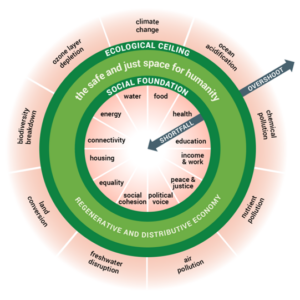
Figure 1. Main indicators regarding social foundation and planetary boundaries, which form the Doughnut model (Doughnut Economics Action Lab 2025)
The Doughnut Economics concept has become more well-known in recent years, mainly in the context of urban and regional planning. To assist cities in operationalizing the concept and making it accessible to people with diverse backgrounds, several tools were created. Eleven cities and regions have used it more extensively and for a longer period, so that they can share their valuable experience. Most of these cases have taken place in Europe and the UK, including Brussels, Grenoble, Glasgow, and Cornwall (Goodwin 2021; Doughnut Economics Action Lab 2024). A visit to Grenoble by experts from Regional Council of Päijät-Häme and LAB University of Applied Sciences in 2025 added practical knowledge of the adaptation of Doughnut Model in city governance connected with ClimateGO project which aims to prepare recommendations for local and regional decision-makers to consider the reality of climate change impacts and actions for climate adaptation and mitigation in their area. (Interreg Europe 2025.)
Local authorities adapting doughnut model – open communication needed
There are some similarities in the approaches the cities have taken to incorporate the doughnut model into their systems. In each project, local officials initiated discussions with senior executives to secure their support, and they disseminated this idea inside their own organizations. One of the main actions that every city conducted was gathering information to create a portrait of the city, describing its current state using the Doughnut model indicators. They were able to recognize areas that require immediate attention and comprehend their local and global effects thanks to this representation. The Doughnut Model was used at the strategic level in most projects, and various assessment tools were developed to evaluate development initiatives throughout a city or region (Doughnut Economics Action Lab 2024; City of Grenoble’s Open City Department 2024; ASBL Confluences 2022).
Benefits included witnessing organizational transformation as a major accomplishment and using the Doughnut model tools to foster cross-departmental collaborations. Additionally, it served as a clear and cohesive structure and strategy for several departments, assisting them in working toward a shared goal. The model’s participatory approach and communication capabilities are highlighted as key benefits. However, there were some difficulties during the integration process. For most cities and regions, persuading individuals and groups participating in the development procedures was the primary obstacle, and because of divergent viewpoints, it was challenging to unite them all under one roof. Converting the model’s indicators into information that was useful and relevant, considering contextual variations, was the other major issue (Doughnut Economics Action Lab 2024).
Co-designing the vision with stakeholders across the city has proven to be an effective step, and open communication between organizations has established a safe space for the discussion of this model. Cities that incorporated Doughnut concepts into their current workflows found success in simplicity, while overcomplication could lead to project failure. All stakeholders must be able to easily use the metrics and tools created to monitor the city’s progress. Many projects have benefited from engaging with other cities to share ideas and experiences, even though the local context is crucial in this process. Lastly, it must be acknowledged that the model’s operationalization process is a long-term process (Doughnut Economics Action Lab 2024; DEAL Team 2022; Hjelmskog et al. 2023). As an experiment, a detailed examination of the Brussels Capital Region’s experience is presented in the following part.
Brussels experience in adopting the Doughnut Model
The implementation of the Doughnut Model by the Brussels capital region represents an application at the regional level which provides a framework for regional decision-making, facilitating an ecological and inclusive transition towards a sustainable society. A four-layer model was established in Brussels to define projects at the macro, meso, micro, and nano levels. At the meso level, existing strategies and action plans were evaluated to assess their conformity with the model’s primary objectives. The projects and activities were subsequently examined at the micro level, encouraging local stakeholders to take action. At this stage, awareness sessions and workshops were conducted for individuals and enterprises to enhance their social and sustainability responsibilities. Finally, everyday products were examined to demonstrate the effects of regular consumption on both local and global scales (ASBL Confluences 2022). The Brussels portrait contains large number of different indicators, chosen through an evaluation process to check their relevance and data availability. However, data acquisition sometimes causes challenges to projects like this. (Dethier et al. 2023.)
The Doughnut Economics Model has been later used in urban planning to create thriving communities (Arnold et al. 2025). Several tools were created along this path, and various cities and regions incorporated its ideas into their planning and governance procedures. Nevertheless, this model’s operationalization requires further work. Recent experiences demonstrate the effectivity of the model in assisting cities in encouraging participation and promoting a sustainable environment. The most important first stages involve establishing an agreement on the benefits of this approach and starting to act with available resources. New cities are expected to join similar development in the future, and they will benefit from the previous experiences in the field.
References
Arnold, B., Meister-Broekema, P., van Wissen, L., Jansma, E., Melis, K. & Bulder, E. 2025. Atlas of Regional Development. A document depicting the landscape of regional development In Europe. PREMIUM_EU. Cited 8 Apr 2026. Available at https://premium-eu.org/fume-publications/atlas-of-regional-development-mapping-the-landscape-of-regional-development-in-europe/
ASBL Confluences. 2022. Brussels Donut. Cited 20 Feb 2026. Available at https://donut.brussels/en/brussels/
City of Grenoble’s Open City Department. 2024. Doughnut Economics: A new compass for thinking the future of Grenoble? Grenoble: City of Grenoble’s Open City Department. Cited 20 Feb 2026. Available at https://www.calameo.com/read/004190376c10227da6667
ClimateGO. 2025. Policy Brief: Climate-Smart Decision-making. Cited 17 Apr 2026. Available at https://www.interregeurope.eu/sites/default/files/2025-05/Policy%20Brief_final.pdf
DEAL Team. 2022. Doughnut Unrolled: Community Portrait of Place. Doughnut Economics Action Lab. Cited 20 Feb 2026. Available at https://doughnuteconomics.org/tools/doughnut-unrolled-community-portrait-of-place
Dethier, F., Goffin, B., Roman, P., Thiry, G. & Vanderstraeten, P. 2023. Doughnut Portrait of the Brussels Capital Region. ASBL Confluences and ICHEC Brussels Management School. Cited 17 Apr 2026. Available at https://acrobat.adobe.com/id/urn:aaid:sc:eu:9fb0f030-108a-4f55-836a-cf457e98e9dd
Doughnut Economics Action Lab. 2025. What is the Doughnut? Cited 28 Feb 2026. Available at https://doughnuteconomics.org/doughnut
Doughnut Economics Action Lab. 2024. Cities and Regions: Let’s get started. Cited 21 Feb 2026. Available at https://doughnuteconomics.org/tools/cities-regions-let-s-get-started
Goodwin, K. 2021. Designing the Doughnut: A Story of Five Cities. Doughnut Economics Action Lab. Cited 20 Feb 2026. Available at https://doughnuteconomics.org/stories/designing-the-doughnut-a-story-of-five-cities
Hjelmskog, A., Toney, J., Scott, M., Crawfors, J., Hasan, C., Winterbottom, J., and Meier, P. 2023. Thriving Glasgow Portrait. Cited 20 Feb 2026. Available at https://www.glasgow-doughnut.co.uk/Thriving%20Glasgow%20Portrait%20Report%20(GALLANT).pdf
Interreg Europe. 2025. ClimateGO – Pathways to Climate-Smart Governance. Cited 21 Feb 2026. Available at https://www.interregeurope.eu/climatego
Raworth, K. 2017. Doughnut Economics: Seven Ways to Think Like a 21st-Century Economist. London: Random House Business Books.
Authors
Razieh Rafiei is a Master student in Erasmus Mundus Master Programme MUrCS – Master in Urban Climate and Sustainability (carried out in cooperation between Glasgow Caledonian University, LAB and University of Huelva). She worked with the Regional Council of Päijät-Häme in a summer internship project concerning doughnut economy in 2025.
Eeva Aarrevaara, DSc(Arch), works as a teacher of urban planning and an expert in RDI projects at LAB University of Applied Sciences. She is also involved with MUrCS programme.
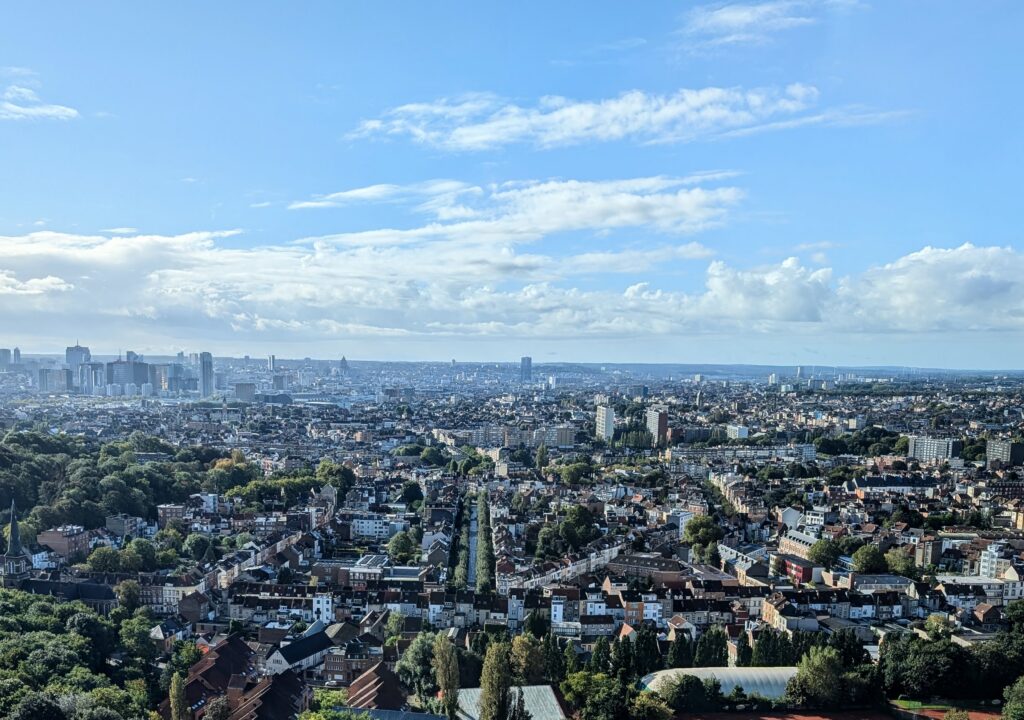
Illustration: The city of Brussels and its surroundings from the viewing platform in the Atomium. https://commons.wikimedia.org/w/index.php?curid=166883831 (MrBenjo, CC BY-SA 4.0)
Reference to this article
Rafiei, R. & Aarrevaara, E. 2026. The Doughnut Economics Model: A sustainable approach to urban planning. LAB Pro. Cited and date of citation. Available at https://www.labopen.fi/lab-pro/the-doughnut-economics-model-a-sustainable-approach-to-urban-planning/