LAB Pro
The city of Lahti and the broader Päijät-Häme region have been a benchmark for environmental excellence in the international context. Lahti attained the European Green Capital title in 2021, and the region has a strong background in circular economy innovation, consistently meeting high standards of sustainability. Natural environment is also highlighted in regional strategies. However, as the global planning trends transition towards more integrated models of development, there is an opening for the region to evaluate its next strategic step. What could be the next leap for a region that has already mastered the ”green” growth model?
Authors: Aditi Ajay & Eeva Aarrevaara
The Doughnut Model: A Compass for Planetary Balance
Drawing from research conducted during a recent internship with the Päijät-Häme Regional Council, this article explores the potential for the region to adopt the Doughnut Economics framework. Developed by economist Kate Raworth (2017), the Doughnut model provides a conceptual visualization that replaces measuring cities with the Gross Domestic Product (GDP) with the objective of meeting the needs of all people within the means of the planet. The framework is structured around two primary boundaries: Firstly, the social foundation meaning an inner ring derived from the UN Sustainable Development Goals (SDGs) which identifies 12 essential social dimensions where no individual should experience a deficit (UNDP). These dimensions include (but are not limited to) healthcare, education, social equity, and housing. Secondly, the ecological ceiling featuring an outer ring comprising nine planetary boundaries that define the environmental limits within which humanity must operate to maintain Earth.
The ”Doughnut” represents the space situated between these two boundaries. For a region like Päijät-Häme, this means that policies that are proposed should be measured by the degree to which it secures the social foundation for its residents without overshooting the ecological carrying capacity of the local and global environment (Raworth 2017). The practical utility of this framework is evidenced by the fact that several other European cities have adopted the model. In Brussels, the model was adopted to provide a holistic ”compass” for the regional circular economy transition. The framework prompted a cross-departmental analysis of how circular initiatives could simultaneously address unemployment and social housing needs. (Brussels Doughnut.)
International Precedents: Lessons from Grenoble
Similarly, Grenoble has utilized Doughnut principles to ensure that its environmental transition remains socially equitable (Doughnut Economics Action Lab 2024). The Doughnut Economics framework was adopted as a ”strategic compass” to guide the city’s long-term vision, Grenoble 2040. Grenoble implemented specific tools to put the model in practice: Firstly, the City Council developed a tool to evaluate PPI (multi-year investment plan) projects. This tool ensures that large-scale infrastructure and policy projects are prioritized based on their ability to meet basic human needs while respecting planetary boundaries. Secondly, in collaboration with the Grenoble Ecole de Management, the city also uses a survey-based observation tool to monitor residents’ behaviours and perceptions regarding major societal and environmental issues (City of Grenoble 2022). The assessment tools led to the implementation of social-climate policies that link environmental goals with social justice, specifically regarding energy poverty and equitable food systems.
Evaluating Päijät-Häme’s Readiness for the Doughnut
Päijät-Häme region possesses a high degree of institutional maturity, suggesting it is a strong candidate for adopting the Doughnut Model. This potential is supported by decades of documented development in the region. Since the 1990s, Päijät-Häme has been a leader in environmental technology and cleantech, when they ditched traditional landfilling for the ”Lahti Model,” founding their regional waste management hub (Interreg Europe 2023). This trajectory led to the Roadmap towards a Circular Economy (Päijät-Häme Regional Council 2017) and the Bio-based Circular Economy Action Plan through the BIOREGIO project (Kivelä, Medkova & Vanhamäki 2022). These research efforts have already established the necessary technical infrastructure for nutrient cycling, biowaste management, and bioenergy production.
Also, the Wellbeing Services County of Päijät-Häme has proactively connected social welfare with ecological health. A primary example is the Nature Step to Health 2022–2032 programme. Conducted in collaboration with the Lahti University Campus, this initiative demonstrates the region’s capacity to link environmental preservation directly to measurable public health outcomes (Wellbeing Services County of Päijät-Häme 2022). Further on, the region benefits from a well-established network of stakeholders and a culture of collaborative governance. Transitioning to a model like the ”Doughnut” represents a logical expansion of current efforts, such as the ClimateGO project. The project focuses on improving regional policies by sharing ”climate-smart” governance practices. (Interreg Europe 2024).
A Roadmap for Päijät-Häme
To move from theory to practice, the region can utilize the Finnish Doughnut Economics Toolbox, launched in June 2022. This resource could provide the ”City Portrait” methodology and indicators designed to help municipal leaders apply the framework to their local context (Käppi 2022). However, as it originated as a time-bound project and is no longer actively maintained online, there needs to be further refinement to create a fully contextualized regional tool. The following roadmap outlines the necessary steps to adapt the model to the specific landscape of Päijät-Häme.
- Acquire baseline data: Gather comprehensive social, economic, and ecological data to map the region’s current position relative to the Doughnut boundaries.
- Stakeholder engagement: Use the ”Community Portrait of a Place” methodology; the region should convene workshops to co-create indicators. This ensures both technical experts and local citizens define what a ”safe and just” Päijät-Häme looks like.
- Embed into institutions: To ensure real change, the model must be integrated into official governance. This includes appointing a dedicated Doughnut Coordinator to apply the ”City Portrait” lens to regional master plans, transport strategies, and public health policies.
- Strategic funding: The region should seek targeted funding from the EU, Business Finland, or Sitra to pilot Decision Support Systems (DSS) that embed Doughnut thresholds directly into regional budgeting and investment decisions.
By adopting the Doughnut Economics framework, Päijät-Häme has the opportunity to evolve from its legacy as a European Green Capital into Finland’s first Thriving Region. A thriving region is a concept introduced by EU in connection with politics and research dealing with multiple aspects of regional development and widening the perspectives of critical factors in a region´s potential for innovation and well-being. (Arnold et al. 2025.) It can provide a model for a mid-sized European functional region which aligns its industrial strengths with the fundamental needs of its people and the limits of the planet.
References
Arnold, B., Meister-Broekema, P., van Wissen, L., Jansma, E., Melis, K. & Bulder, E. 2025. Atlas of Regional Development. A document depicting the landscape of regional development In Europe. Cited 8.4.2026. Available https://premium-eu.org/fume-publications/atlas-of-regional-development-mapping-the-landscape-of-regional-development-in-europe/
Brussels Doughnut. Cited 8.4.2026. Available https://donut.brussels/en/brussels/
City of Grenoble. 2022. New Compass for Grenoble: Doughnut Economics. Cited 4 Mar 2026. Available at https://www.calameo.com/read/004190376c10227da6667
Doughnut Economics Action Lab. 2024. Cities and Regions: Let’s get started. Cited 21 Feb 2026. Available at https://doughnuteconomics.org/tools/cities-regions-let-s-get-started
Interreg Europe. 2023. The kick-off of the CITISYSTEM project in Lahti, Finland. News. Cited 21 Feb 2026. Available at https://www.interregeurope.eu/citisystem/news-and-events/news/the-kick-off-of-the-citisystem-project-in-lahti-finland
Interreg Europe. 2024. ClimateGO – Pathways to Climate-Smart Governance. Cited 21 Feb 2026. Available at https://www.interregeurope.eu/climatego
Käppi, M. 2022. The Finnish Doughnut Economics Toolbox. Doughnut Economics Action Lab. Cited 21 Feb 2026. Available at https://doughnuteconomics.org/tools/the-finnish-doughnut-economics-toolbox
Kivelä, R., Medkova, K. & Vanhamäki, S. 2022. Policy development and support measures for circular economy in Päijät-Häme. LAB Focus. Blog post. Cited 18 Feb 2026. Available at https://blogit.lab.fi/labfocus/en/policy-development-and-support-measures-for-circular-economy-in-paijat-hame/
Päijät-Häme Regional Council. 2017. Päijät-Häme Roadmap towards Circular Economy. Cited 18 Feb 2026. Available at https://paijat-hame.fi/wp-content/uploads/2021/03/Roadmap_CE_eng.pdf
Raworth, K. 2017. Doughnut Economics: Seven Ways to Think Like a 21st-Century Economist. London: Random House Business Books.
UNDP. Cited 8.4.2026. Available at https://www.undp.org/sustainable-development-goals
Wellbeing Services County of Päijät-Häme. 2022. Nature Step to Health programme 2022–2032. Cited 18 Feb 2026. Available at https://paijatha.fi/en/nature-step-to-health-programme-2022-2032/
Authors
Aditi Ajay is a Master student in Erasmus Mundus Master Programme MUrCS – Master in Urban Climate and Sustainability (carried out in cooperation between Glasgow Caledonian University, LAB and University of Huelva). She worked with the Regional Council of Päijät-Häme in a summer internship project concerning doughnut economy in 2025.
Eeva Aarrevaara, DSc(Arch), works as a teacher of urban planning and an expert in RDI projects at LAB University of Applied Sciences. She is also involved with MUrCS programme.
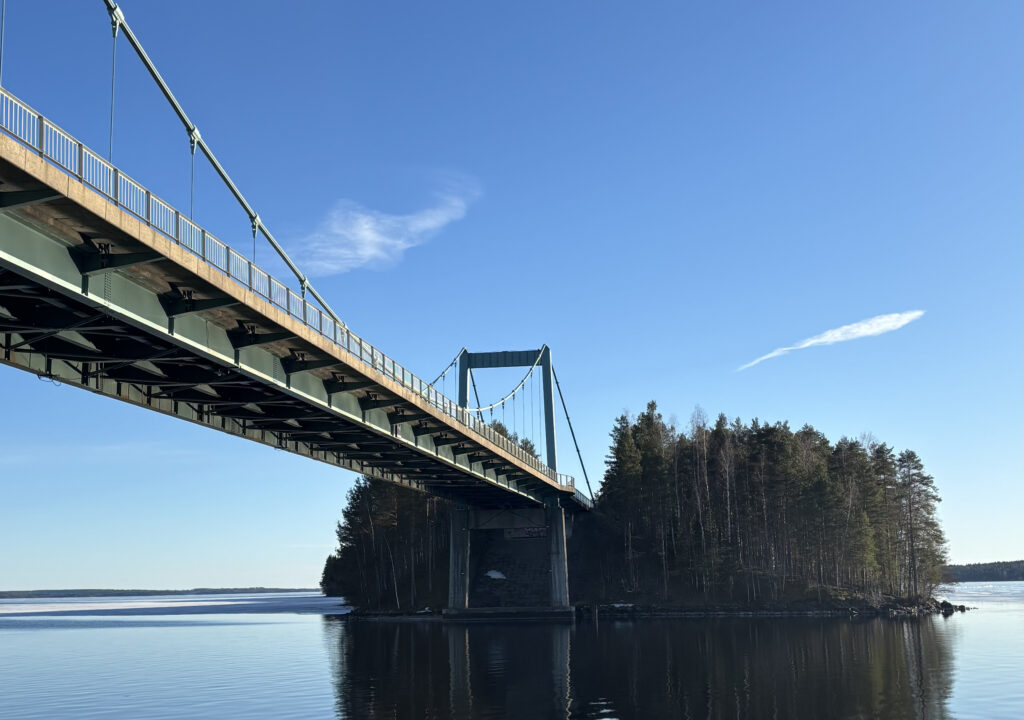
Illustration: The view of Karisalmi bridge in Päijänne National Park, representing the region’s ecological foundation (Image: Aditi Ajay).
Reference to this article
Ajay, A. & Aarrevaara, E. 2026. Could Päijät-Häme become Finland’s first Doughnut region? LAB Pro. Cited and date of citation. Available at https://www.labopen.fi/lab-pro/could-paijat-hame-become-finlands-first-doughnut-region/