LAB Pro
Five regions from Finland, Denmark, Greece, Ukraine, and the Netherlands, are on a joint journey towards carbon neutrality in the Interreg Europe project CLIBUS. To achieve climate goals, these regions will build capacity of public authorities to improve the collaboration with business sector. In this article, the climate goals and current state of greenhouse gas emissions of each CLIBUS region are introduced.
Authors: Eliisa Punttila, Katerina Medkova and Erika Tapaninen
European Union aims to achieve carbon neutrality by 2050 and is committed to reduce greenhouse gas emissions by 55% in 2030 compared to 1990 level (European Commission 2025a & 2025b). Municipalities, cities and regions across Europe are on the pathway towards carbon neutrality, some aiming to achieve the carbon neutrality already by 2030, or by 2050 at latest.
In May 2025, a new project CLIBUS, co-funded by EU under the Interreg Europe programme, was launched to promote this development. The CLIBUS – Runway to carbon neutrality – Involvement of business communities in climate strategies project, is especially focused on the capacity of public authorities in supporting business communities and SMEs in their energy-efficiency and climate actions. Improved public-private collaboration is essential, since business sector often contributes a large share of regional greenhouse gas emissions. (Interreg Europe 2025.)
The key element of the CLIBUS project is learning and experience exchange between the public authorities participating in the project. CLIBUS partnership consists of five regions. LAB University of Applied Sciences acts as the lead partner of the CLIBUS project and cooperates with Imatra in its regional implementation
Imatra, Finland
The City of Imatra aims to achieve carbon neutrality by 2030, meaning that the greenhouse gas emissions should reduce by 80 % by 2030 compared to 2007 level. In Imatra, the first climate program was made already in 2009. The climate program decided to be updated in 2019, when the city also decided to join in the network of carbon neutral municipalities, HINKU. (Imatran kaupunki 2020, 2.)
Currently, Imatra is in a good phase. The greenhouse gas emissions in Imatra have reduced by 63 percent by year 2023 compared to 2007 level, which is more than the national average in urban municipalities. Emissions start very high in 1990 and then steadily drop over the years. The biggest decreases come from electricity use, district heating, and transport. (Finnish Environment Institute 2025.). Annual reduction and share of sectors are illustrated in Picture 1.
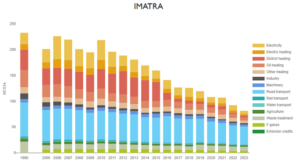 Figure 1. Greenhouse gas emissions per sector in Imatra in 1990 and during 2005-2023 (Finnish Environment Institute 2025).
Hillerød, Denmark
Municipality of Hillerød aims to be carbon neutral by year 2050. According to the climate plan approved in 2023, Hillerød has set a goal to reduce greenhouse gas emissions by 64% by 2030 compared to 2019 level. Hillerød is also part of national DK2020 project, collaborating with other municipalities in Denmark. (Hillerød Kommune 2025a.) In 2025, all municipalities in Denmark have done the climate plan, thanks to DK2020 (Realdania 2025).
Hillerød’s climate plan “Together for climate and green transition” outlines how the municipality will reduce CO₂ emissions and reach climate neutrality by 2050 through major changes in seven focus areas: (1) Energy and heat, (2) Transport and mobility, (3) Land and agriculture, (4) Consumption and resources, (5) Climate adaptation, (6) Together on climate, and (7) Climate management. (Hillerød Kommune 2025a.) The Action Plan 2023–2027 is an integral part of Hillerød’s climate plan, turning big climate goals into concrete steps. It recognises that climate action is not only about cutting emissions, but also about improving everyday life, protecting local nature, and making the community stronger and more resilient. (Hillerød Kommune 2025b.)
The climate plan also presents a long-term reduction pathway toward 2050 (Figure 2), showing how different sectors must continue to cut emissions and where the main challenges and remaining potentials lie on the journey to climate neutrality (Hillerød Kommune 2025c).
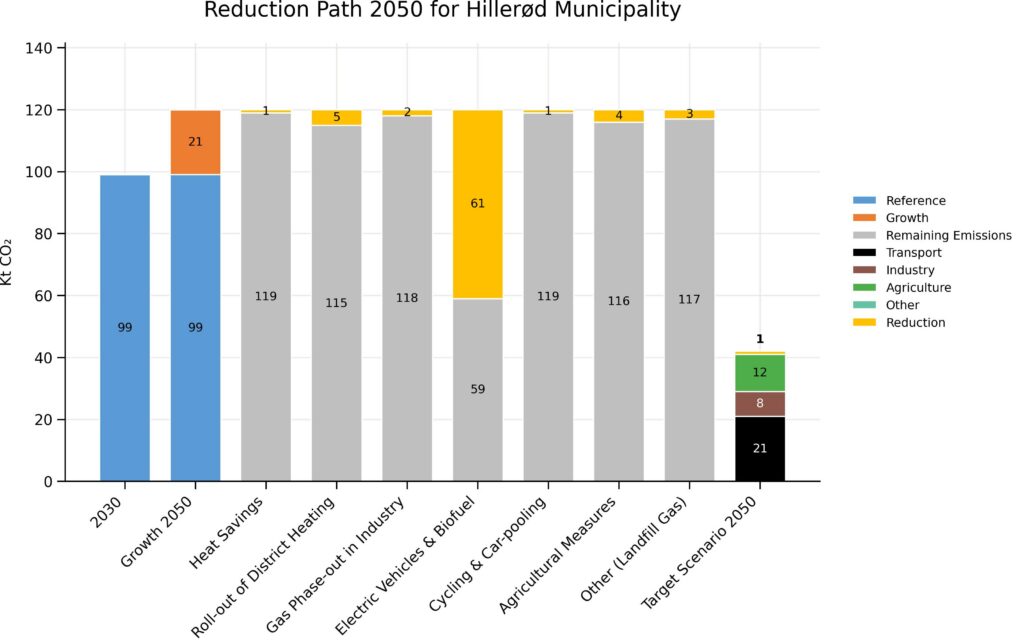
Figure 2. CO₂ Emission Reduction Pathway for Hillerød Municipality (2030–2050) (adapted and translated based on Hillerød Kommune 2025c).
Thessaly, Greece
The region of Thessaly aims to become the first climate‑neutral region in Greece and has set its main goals for 2030. The region is helping its major cities move toward climate neutrality: Trikala is already part of the EU Cities Mission programme, and work is underway to include Larissa, Volos, and Karditsa, so that eventually all Thessalian cities follow the same path. To reach the 2030 targets, Thessaly is preparing Climate Neutrality Action Plans funded by the region. These plans focus on reducing emissions by upgrading buildings to use less energy and more renewables, improving transport with bike lanes, better public transport, and more electric vehicles, and creating more green spaces and parks to improve air quality and city life by 2030. (Perifereia Thessalias 2025.)
Trikala’s Climate City Contract outlines how the city will structure its path toward achieving climate neutrality by 2030 within the EU Cities Mission framework. Rather than listing individual actions, it describes the process the city will follow to build a realistic and coordinated path forward. Part B explains this process; Trikala will explore different scenarios for reaching climate neutrality, create a portfolio of interventions that fit together into a coherent plan, and set up indicators to monitor progress and learn along the way. Together, these steps form the backbone of how the city will move from today’s emissions situation toward a climate‑neutral future in a structured and evidence‑based way. (2030 Climate Neutrality Action Plan of Trikala 2026, 73-338.)
Rivne, Ukraine
Rivne has emerged as a leading city in Ukraine’s climate transition by committing to climate neutrality by 2050 and becoming the first and only Ukrainian city selected for the EU NetZeroCities programme, alongside 52 European pilot cities. The city joined the Covenant of Mayors in 2014 and has already reduced its greenhouse gas emissions by around 20% compared to 2010 levels, with a target of approximately 30% reduction by 2030. Core activities focus on improving energy efficiency, reducing emissions, and shifting toward renewable energy through better data and planning. (Rivne Department of Economic Development 2025)
A concrete example of this approach is the development of a Municipal Energy Passport, which brings together energy consumption data from municipal buildings into a single digital system to support investment decisions and scenario modelling for the city’s path toward climate neutrality. (NetZeroCities 2026.)
Emmen, the Netherlands
Emmen has set a long‑term objective to become a prosperous and CO₂‑neutral municipality by 2050, recognising that economic development and climate neutrality must go hand in hand. This is especially important in Emmen, where the local economy uses a lot of energy and household energy consumption is higher than the Dutch average. As a result, access to reliable and affordable energy is essential for both economic strength and everyday life in the municipality.
Most energy use in the municipality comes from industry, other businesses and greenhouse horticulture, which together account for about 70% of total consumption, while natural gas makes up more than 70% of the energy mix. SMEs and organizations face different challenges. Although they are responsible for around 34% of energy use, energy costs have not usually been a major focus, and knowledge of energy efficiency is often limited. Recent rises in gas and electricity prices have highlighted this situation and point to clear opportunities to improve efficiency and better support SMEs as part of Emmen’s path toward climate neutrality. (Gemeente Emmen 2023.)
Conclusions
The CLIBUS project shows that although the five partner regions are at different stages on their path to carbon neutrality, they all share the same goal and face similar challenges. Each region has its own characteristics and development needs that shape its transition pathway, and SMEs play a key role in this change. As SMEs may account for a significant share of regional energy use, improving how regions engage with them and sharing practical knowledge on emission reduction is essential. By learning from each other and strengthening cooperation with SMEs, the regions can take more effective climate actions and move faster toward a carbon neutral future.
References
Imatran kaupunki. 2020. Vähähiilinen Imatra. Imatran ilmasto-ohjelma 2020-2030. Cited 27 Nov 2025. Available at https://www.imatra.fi/sites/default/files/atoms/files/Vahahiilinen-Imatra-Aukeama_2020%E2%80%932030.pdf
European Commission. 2025a. 2030 climate targets. Cited 27 Nov 2025. Available at https://climate.ec.europa.eu/eu-action/climate-strategies-targets/2030-climate-targets_en
European Commission. 2025b. 2050 long-term strategy. Cited 27 Nov 2025. Available at https://climate.ec.europa.eu/eu-action/climate-strategies-targets/2050-long-term-strategy_en
Finnish Environment Institute. 2025. GHG emissions of Finnish municipalities and regions. Cited 27 Nov 2025. Available at https://paastot.hiilineutraalisuomi.fi/#en_kunta153
Interreg Europe. 2025. CLIBUS – Runway to carbon neutrality: Involvement of business communities in climate strategies. Cited 22 Apr 2026. Available at https://www.interregeurope.eu/clibus
Gemeente Emmen. 2023. Energienota 2023-2026 Cited 7 Apr 2026. Available at https://repository.officiele-overheidspublicaties.nl/externebijlagen/exb-2023-52209/1/bijlage/exb-2023-52209.pdf
Hillerød Kommune. 2025a. Klimaplan og handleplan. Cited 27 Nov 2025. Available at https://www.hillerod.dk/demokrati-og-indflydelse/vision-politikker-og-strategier/klimaplan-og-handleplan/
Hillerød Kommune. 2025b. Handleplan 2023-27. Cited 8 Mar 2026. Available at https://hillerod.viewer.dkplan.niras.dk/plan/30#/14855
Hillerød Kommune. 2025c. Reduktionssti 2030-2050 og det der er tilbage (’manko’). Cited 8 Mar 2026. Available at https://hillerod.viewer.dkplan.niras.dk/plan/30#/14892
NetZeroCities. 2026. Rivne’s Pilot City Activity: Creating a NetZero vision for Rivne. Cited 8 Apr 2026. Available at https://netzerocities.eu/rivnes-pilot-city-activity-creating-a-netzero-vision-for-rivne/
Perifereia Thessalias. 2025. I Thessalia i proti Perifereia stin chóra pou allázei to klimatikó tis méllon [Thessaly: The first Region in the country that is changing its climate future]. Cited 8 Mar 2026. Available at https://www.thessaly.gov.gr/enimerosi/deltiotypou/47003
Realdania. 2025. DK2020. Cited 28 Nov 2025. Available at https://www.realdania.org/whatwedo/grants-and-projects/dk2020
Rivne Department of Economic Development. 2025. NetZeroCities. Cited 7 Apr 2026. Available at https://economy.rivnerada.gov.ua/services/netzerocities/
2030 Climate Neutrality Action Plan of Trikala. 2026. Climate City Contact. Net Zero Cities. Cited 8 Mar 2026. Available at https://netzerocities.app/_content/files/knowledge/4453/trikala_ccc.pdf
Authors
RDI Specialist Eliisa Punttila from the Faculty of Technology is the project manager of the CLIBUS project and is currently on parental leave.
RDI Specialist Katerina Medkova from the Faculty of Technology is currently the project manager of the CLIBUS project.
RDI Specialist Erika Tapaninen from the Faculty of Technology is the communication manager of the CLIBUS project.
Illustration: https://pxhere.com/fi/photo/784140 (CC0)
Reference to this article
Punttila, E., Medkova, K. & Tapaninen, E. 2026. Together towards carbon neutrality across European regions. LAB Pro. Cited and date of citation. Available at https://www.labopen.fi/en/lab-pro/together-towards-carbon-neutrality-across-european-regions/