LAB Pro

ESG reporting helps companies understand and communicate their sustainability performance, but reporting does not automatically lead to measurable climate action. Recent research highlights, that Micro and SMEs often face challenges due to limited knowledge, resources and support when translating ESG information into measurable climate action. Research and European good practices suggest that ESG reporting is most effective when combined with practical support, capacity building, and implementation assistance.
Authors: Masoomeh Vaezi & Ismo Nieminen
ESG reporting helps companies understand and communicate their sustainability performance, but reporting does not automatically lead to measurable climate action. Recent research highlights, that Micro and SMEs often face challenges due to limited knowledge, resources and support when translating ESG information into measurable climate action. Research and European good practices suggest that ESG reporting is most effective when combined with practical support, capacity building, and implementation assistance.
ESG reporting is becoming increasingly important for SMEs
Environmental, Social and Governance (ESG) reporting has become an increasingly relevant tool for improving sustainability, transparency, and accountability in organizations. It covers a wide range of indicators, including energy consumption, greenhouse gas emissions, resource use, waste generation, social impacts, and governance practices.
For small and medium-sized enterprises (SMEs), which account for approximately 99% of businesses in EU (European Commission 2023), sustainability reporting is becoming increasingly relevant. Recent frameworks and regulations, including the Corporate Sustainability Reporting Directive (CSRD) and the voluntary sustainability reporting standard for SMEs (VSME), have increased interest in ESG disclosure among smaller companies. However, ESG reporting alone does not automatically lead to measurable climate action.
Recent evidence from research and good practices has shown that ESG disclosure and emissions measurement do not necessarily lead to climate action. Grippo, Di Piazza, and Mazzarella (2025) highlight the role of structured sustainability reporting, while Treepongkaruna et al. (2024) show that companies ESG disclosure is a firm’s publicity tool rather than a firm’s commitment to do good measurable for the environment. Practical initiatives, such as Denmark’s Green Ambassadors and Ireland’s EXEED programme (SEAI n.d.a), illustrate how facilitators can help to translate sustainability information into prioritized actions and measurable outcomes. This study examines practical mechanisms for micro and small enterprises in transforming ESG data into measurable climate action.
Why reporting alone is often not enough
The strategy for transforming environmental, social, and governance issues into evaluable reports is to integrate them with measurable frameworks. Well-known frameworks include the GRI, TCFD, CSRD, ESRS, and VSME. Although these frameworks can enhance transparency and accountability, SMEs often face a lack of sustainability knowledge, limited internal capacity, and complexity in applying these frameworks.
Research shows that high ESG ratings do not automatically lead to lower emissions or improved environmental performance (Treepongkaruna et al. 2024). Nyakuwanika and Panicker (2025) emphasize that variation in reporting frameworks and regions leads to the incomparability and sometimes incompleteness of reports. Furthermore, reporting alone is insufficient to achieve measurable environmental improvements, particularly for small and medium-sized enterprises with limited resources. Organizations need to take practical steps to improve their environmental performance, rather than just reporting their results. These steps can include investing in energy efficiency and regularly monitoring progress (SEAI n.d.b).
Barriers for SMEs
Micro and small enterprises often face several interconnected barriers when attempting to transform ESG data into climate action. SMEs may lack sustainability specialists and carbon accounting expertise. Consequently, ESG reporting can become an administrative burden rather than a management tool.
Limited technical knowledge prevents SMEs from identifying relevant indicators, calculating emissions, and translating data into action. The Green Ambassadors initiative in Sønderborg illustrates how sustainability training and community engagement can raise environmental awareness and promote sustainable practical actions (ProjectZero 2026).
Financial barriers may delay implementation. The EU EENergy programme, which funded energy-efficiency measures for 950 companies, illustrates the importance of combining ESG information with financial and technical support (Enterprise Europe Network 2026).
The biggest challenge is limited access to sustainability expertise and external networks. The Energy Hub in the Netherlands and the Greenreality Network in South Karelia demonstrate how local intermediaries and support structure can facilitate climate action by promoting cooperation, knowledge sharing, and practical sustainability measures (Energiehubs.nl n.d.; RVO 2024; Greenreality Network n.d.). These barriers are connected: limited knowledge affects data quality, insufficient data complicates prioritisation of actions, financial constraints delay implementation, lack of proper checks makes progress difficult.
Turning ESG data into measurable results
Research suggests that ESG reporting should be viewed as a starting point rather than an end goal. Companies need mechanisms that connect reporting with practical implementation.
The first step is collecting key ESG indicators, including energy consumption, greenhouse gas emissions, material use, waste generation, and climate targets. Establishing a baseline allows organizations to prioritize improvement actions.
However, data alone is not enough. SMEs also benefit from guidance, external expertise, and intermediary organizations that can help interpret information and convert it into practical actions. Research has shown that external advice can significantly support the adoption of resource-efficient practices in SMEs (Bodas Freitas & Corrocher 2019). European initiatives further demonstrate the importance of combining sustainability information with mentoring, training, implementation support, and access to financing.
A practical pathway for SMEs therefore consists of five steps: (1) Measure current environmental performance, (2) Establish a baseline, (3) Identify environmental hotspots and priorities, (4) Implement improvement measures, and (5) Monitor and verify results.
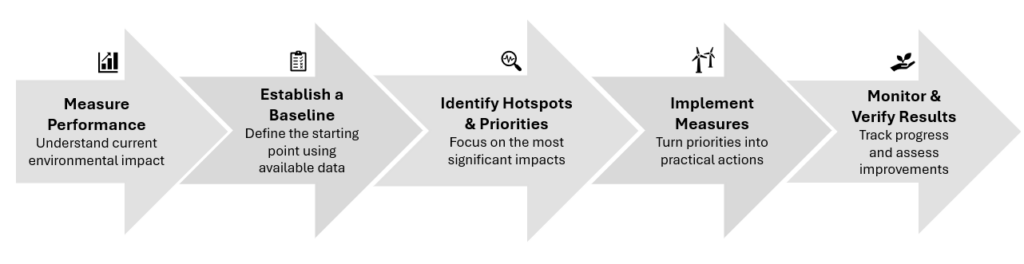
Figure 1. A five-step pathway from ESG data to measurable climate action in micro and small enterprises.
What can regions and support organisations do?
Experiences from across Europe indicate that SMEs rarely need additional reporting requirements. Instead, they need accessible support structures that help them understand sustainability data and act on it.
This is also an important consideration for regional development initiatives such as the CLIBUS project, which seeks to strengthen climate action among small businesses. Local support organizations, development agencies, intermediary networks, and capacity-building programmes can play a crucial role in helping companies move from disclosure to implementation (Interreg Europe 2025).
The most successful examples combine sustainability knowledge, practical guidance, external expertise, implementation support, and access to financing within a single support ecosystem.
From disclosure to action
ESG reporting remains an important tool for transparency and sustainability management. However, reporting alone does not guarantee environmental improvement.
Measurable climate action requires a combination of reliable data, climate targets, practical guidance, implementation support, and access to expertise and financing. By establishing greenhouse gas baselines, identifying environmental hotspots, setting measurable targets, and utilizing support mechanisms, micro and small enterprises can turn ESG disclosure into meaningful climate action.
References
Bodas Freitas, I.M. and Corrocher, N. 2019. The use of external support and the benefits of the adoption of resource efficiency practices: An empirical analysis of European SMEs. Energy Policy. Vol. 132, 75–82. Cited 14 Oct 2026. Available at https://doi.org/10.1016/j.enpol.2019.05.019
Energiehubs.nl. n.d. Knowledge platform energyhubs in The Netherlands. Cited 14 Oct 2026. Available at https://www.energiehubs.nl/en-en/knowledge-platform-energyhubs
Enterprise Europe Network. 2026. Enabling significant change through small grants – the success of cascade funding with EENergy and Enterprise Europe Network. Cited 14 Oct 2026. Available at https://een.ec.europa.eu/news/enabling-significant-change-through-small-grants-success-cascade-funding-eenergy
European Commission. 2023. SME Relief Package. Cited 14 Oct 2026. Available at https://eur-lex.europa.eu/legal-content/EN/TXT/?uri=CELEX:52023DC05
Greenreality Network. n.d. General information about the Network. Cited 14 Oct 2026. Available at https://greenreality.fi/en/activities/general-information-about-the-network/
Grippo, V., Di Piazza, A. & Mazzarella, F. 2025. A new paradigm in corporate reporting: The Corporate Sustainability Reporting Directive (CSRD). Economia Pubblica. 2025(1), 137–146. Cited 14 Oct 2026. Available at https://doi.org/10.3280/EP2025-001006
Interreg Europe. 2025. CLIBUS – Runway to carbon neutrality – Involvement of business communities in climate strategies. Cited 14 Oct 2026. Available at https://www.interregeurope.eu/clibus
Nyakuwanika, M. & Panicker, M. 2025. The role of environmental accounting in mitigating climate change: ESG disclosures and effective reporting—A systematic literature review. Journal of Risk and Financial Management. Vol. 18(9), Article 480. Cited 14 Oct 2026. Available at https://doi.org/10.3390/jrfm18090480
ProjectZero. 2026. Green Ambassadors. Cited 14 Oct 2026. Available at https://projectzero.dk/en/initiativ/green-ambassadors/
RVO. 2024. Handreiking Stimuleringsprogramma Energiehubs 2024. Cited 14 Oct 2026. Available at https://www.rvo.nl/sites/default/files/2024-10/Handreiking-Stimuleringsprogramma-Energiehubs-2024.pdf
SEAI. n.d.a. Excellence in Energy Efficient Design (EXEED). Cited 14 Oct 2026. Available at https://www.seai.ie/grants/business-grants/exeed
SEAI. n.d.b. Steps to energy efficiency. Cited 14 Oct 2026. Available at https://www.seai.ie/plan-your-energy-journey/for-your-business/steps-to-energy-efficiency
Treepongkaruna, S., Au Yong, H.H., Thomsen, S. & Kyaw, K. 2024. Greenwashing, carbon emission, and ESG. Business Strategy and the Environment. Vol. 33(8), 8526–8539. Cited 14 Oct 2026. Available at https://doi.org/10.1002/bse.3929
Authors
Masoomeh Vaezi holds a degree in Architecture and is currently studying Sustainable Solutions Engineering at LAB University of Applied Sciences, Finland. Her academic interests include sustainability, climate action and practical sustainability solutions.
Ismo Nieminen works as an RDI Specialist at LAB University of Applied Sciences, contributing to the RELE – Solutions for Regional Sustainability and Energy Efficiency and CLIBUS projects, and serves as Project Manager of the PH SivuvirtaSalkku project.
Illustration: https://www.pexels.com/fi-fi/kuva/ryhma-ihmisia-pinoamassa-kasia-7793687/ (Pexels License)
How to cite
Vaezi, M. & Nieminen, I. 2026. From ESG disclosure to measurable climate action: mechanisms for micro and small enterprises. LAB Pro. Cited and the date of citation. Available at https://www.labopen.fi/lab-pro/from-esg-disclosure-to-measurable-climate-action-mechanisms-for-micro-and-small-enterprises/
This article was prepared as part of the CLIBUS (Climate-Neutral Business Support) project, an Interreg Europe project that supports regions in improving policy instruments and support mechanisms that help small and medium-sized enterprises advance climate action and sustainability transitions.