LAB Pro
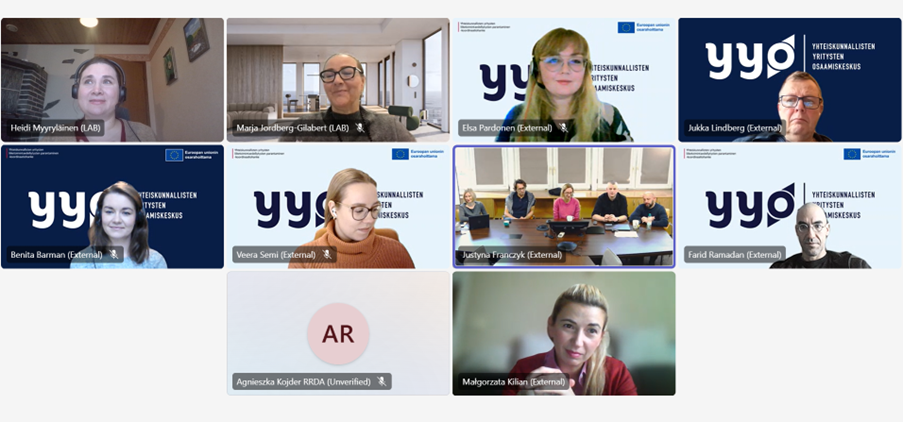
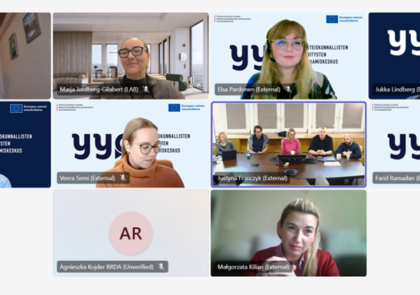
In this article, we tell about an online event organized by Distance LAB -project, where the project had a chance to bring together Finnish and Polish regional developers and social enterprise ecosystem actors. This discussions reflected some differences in countries but also shared aims and collaboration opportunities.
Authors: Heidi Myyryläinen & Marja Jordberg-Gilabert
The Distance LAB project has established an International Multidisciplinary Living Labs Network, which brings together Living Labs across partner countries to support collaborative problem-solving and innovation among universities, businesses, public institutions, and NGOs (Distance LAB). As living labs are plaforms for collaboration, the project brought together Polish and Finnish actors to explore developments in the social enterprise and social economy landscapes in these countries. For the participants, social enterprises and social economy are part of everyday work. In simple terms, the social economy refers to organizations that combine economic activity with a clear social purpose. They address societal challenges while operating as businesses. At the European level, this field is recognized as an important contributor to inclusive and sustainable development (European Commission 2026a; European Commission 2026b ).
What became clear during the discussion is that Poland and Finland operate within different policy frameworks yet share a common ambition: to strengthen economic and social inclusion in society from multiple perspectives.
Polish partners are operating in a system that has become more structured in recent years. The National Program for the Development of Social Economy provides strategic direction, and the Social Economy Act (2022) formally defines and recognizes social enterprises (OECD 2025). New legislation introduced in 2023 further clarified the framework. In other words, social enterprises have a formal recognition. As discussed during the meeting, formalisation is both an opportunity and a challenge: it strengthens credibility but requires capacity for fulfilling administrative requirements.
Social innovations through tailored employment and inclusion paths
Partners shared an interesting example of ALMA (SI+) in Poland. The initiative supports vulnerable young people through tailored pathways towards employment and inclusion. It demonstrates how experimental development, testing new models in practice, can generate social innovation when public authorities, enterprises, and support organizations collaborate across sectors. The aim is to build sustainable pathways that respond to complex life situations.
There was also discussion about the role of business incubators, such as those presented by “Business Money”. These incubators support the creation of new social enterprises by offering legal, marketing, tax, and accounting services. They lower the threshold for turning socially driven ideas into viable organizations. The support ecosystem plays a key role in enabling entrepreneurship that might otherwise remain informal or unrealized.
Interestingly, Polish social enterprises have drawn inspiration from Italian models and adapted them to local conditions. Today, Poland hosts a wide variety of social enterprise models operating in social services, education (especially services for children), marketing, catering, and even barbershops. Many of these enterprises enable self-employment for young people and emphasize flexible working hours, inclusion, and therapeutic elements. The diversity reflects both policy support and regional characteristics.
In Finland, the landscape appears somewhat different. Socially oriented enterprises are more often embedded within broader employment, welfare, and innovation policies (European Commission 2026a). The ecosystem is network-based, building on strong cooperative traditions and cross-sector collaboration. The structure is less formalized compared to Poland, but partnerships and regional initiatives play a significant role.
The Finnish Government’s Communal Economy and Social Enterprises Strategy 2026–2030 (Government of Finland 2025) further highlights how policy supports experimentation, capacity-building, and regional cooperation. It encourages organizations to develop innovative solutions to social challenges while remaining responsive to local realities. The Finnish model encourages cross-sectoral collaboration and experimentation. It underlines conditions for flexible and adaptable practices.
Shared concerns and shared aspirations
Despite these structural differences, the meeting highlighted shared concerns and shared aspirations. Actors in both countries are working to increase visibility, strengthen regional cooperation, improve access to funding, and ensure long-term sustainability. Institutional frameworks shape how these goals are pursued, but the underlying mission is similar.
The most valuable outcome of the meeting was learning from each other´s organizations. Experimental initiatives such as ALMA, structured incubator models in Poland, and Finland’s network-oriented approaches each offer transferable insights. The goal is not to copy one model to another context, but to explore how organizations operate in different policy environments and how joint efforts can enhance learning and social impact.
Looking ahead, there is clear potential for joint projects. Organizations learn from each other’s practices, practical experiments, and regional experiences, discovering new ways to tackle social challenges, innovate, and combine strengths. International collaboration can inspire fresh ideas and helps create solutions that can be both locally relevant and informed by global perspectives. The shared goal is to build more inclusive and resilient regions where economic activity and social impact reinforce each other.
References
Distance LAB. Living LABs – International Multidisciplinary Living LABs network. Accessed 22 February 2026 Available at https://distancelab.eu/livinglabs/
European Commission. 2026a. Finland – EU Social Economy Gateway. Cited 22 Feb 2026. Available at https://social-economy-gateway.ec.europa.eu/my-country/finland_en
European Commission. 2026b. Poland – EU Social Economy Gateway. 18 Dec 2025 Available at https://social-economy-gateway.ec.europa.eu/my-country/poland_en
OECD. 2025. Social Economy in Europe: Poland. OECD Publishing, Paris. Cited 22 Feb 2026. Available at https://www.oecd.org/en/publications/social-economy-in-europe_12970cca-en/poland_816fe295-en.html
Government of Finland. 2025. Yhteisötalouden ja yhteiskunnallisten yritysten strategia 2026–2030 [Communal Economy and Social Enterprises Strategy 2026–2030]. Valtioneuvoston julkaisuja 2025:116. Cited 22 Feb 2026. Available at https://urn.fi/URN:ISBN:978-952-383-050-9
Authors
Heidi Myyryläinen is an RDI expert at LAB University of Applied Sciences.
Marja Jordberg-Gilabert is a Senior Lecturer at LAB University of Applied Sciences.
Illustration: Heidi Myyryläinen
Reference to this article
Myyryläinen, H. & Jordberg-Gilabert, M. 2026. Exchanging experiences between Finnish and Polish regional developers and social enterprise ecosystem actors. LAB Pro. Cited and date of citation. Available at https://www.labopen.fi/lab-pro/exchanging-experiences-between-finnish-and-polish-regional-developers-and-social-enterprise-ecosystem-actors/