LAB Pro
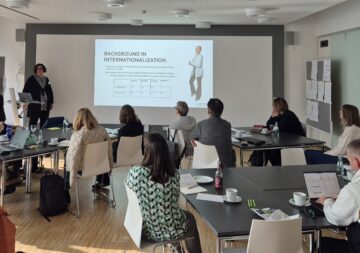
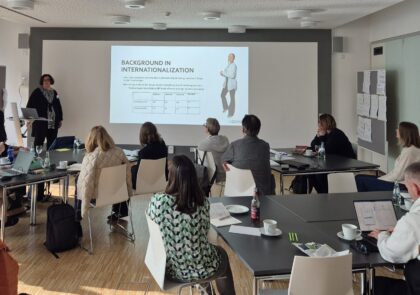
Collaboration in terms of a joint Blended Intensive Programme (BIP) on the course of Global Citizenship and Sustainable Innovations continued with htw Saar from Germany and Avans University of Applied Sciences from the Netherlands. LAB University of Applied Sciences welcomed a diverse group of German and Dutch students to learn about how to deal with textile waste, to learn about global citizenship and to enjoy a true Finnish winter.
Author: Jaana Häkli
Every year 92 million tons of textile waste is produced globally. End-of-life textiles constitute a significant challenge within contemporary circular economy frameworks, as increasing consumption and shortened garment lifecycles contribute to rising volumes of discarded clothing. (Jäppinen 2026.)
Many of us had never heard of the Atacama Desert in Chile before mountains of clothes, even completely unused ones, became global news and people awoke to the problems of fast fashion. Many believe also that simple awareness of global challenges is what global citizenship is about and do not realize that global citizenship includes issues such as personal responsibility, engagement and concrete actions. Developing efficient systems for textile collection, sorting, and reuse is therefore essential for reducing environmental pressures and ensuring that valuable materials remain within production and are reused (European Environment Agency 2023). A structured approach to textile recovery not only diminishes waste generation but also supports broader sustainability objectives by limiting the demand for virgin resources.
Cultural differences in sustainability actions
According to Environmental Performance Index (2024) countries involved in SustainaCycle project and BIP have clear differences in their recycling metrics. Finland, Sweden, Germany and the Netherlands have general recycling rates of 97% – 99% whereas Estonia has 79% and Latvia only 40%. Exact figures for textile waste are not known as they have never been published, yet countries vary also in the length of their history and tradition in recycling. Deposit recycling system was introduced in Sweden in 1984, in Finland in 1996 whereas it was launched in Latvia first in 2022 which can mean that taking bottles back to the store might not yet be an automatic act of good but can still be seen perhaps even as a nuisance. Awakening to environmental issues takes time and even more so when it comes to implementing thoughts into actions. In Finland 11.6 kg of textile waste per person end up in mixed household waste even if since 2025 the waste framework directive from the European Commission mandates having separate collection systems for used textiles. (Jäppinen 2026.)
The Interreg Project SustainaCycle (LAB 2026) collaborated with the BIP and gave international student groups an authentic case study to work on. Students had to create an idea how to boost recycling rates of textile waste and what kind of a digital solution could be used on the container to motivate consumers to recycle and to educate them to recycle correctly. In addition, students had to produce content for the digital solution and to create a public awareness campaign to launch the pilot container. In their work competences such as systems thinking, marketing, understanding of consumer behavior as well as teamwork and communication skills were needed.
Responsible sustainability communication: simple, measurable and user friendly
Public awareness campaigns play a crucial role in strengthening textile recycling initiatives. Effective communication strategies help citizens understand what qualifies as textile waste, why recycling matters, and how individual actions contribute to sustainability. By combining well-designed digital interfaces with compelling outreach efforts, recycling projects can foster more responsible consumption patterns and support the transition towards a circular textile economy (EMF 2019; Pal et al. 2020). According to principles of responsible sustainable communication, it is important that sustainability efforts are understandable, measurable based on facts and e.g. show progress and personal contribution so that the end consumer gets a good feeling of the recycling act completed. This kind of responsible sustainable communication more often leads to a transformative change in individual’s behavior making recycling into an everyday practice that is no longer seen as a nuisance. A true change in person’s values and behavior patterns then again is essentially a manifestation of the power of transformative learning and a step towards global citizenship.
Creativity pays off
Multicultural student groups’ ideas varied from gamification solutions to incentives including getting vouchers after dropping off textile waste for recycling as well as on how to utilize sensors and AI in weighing the textile waste and sharing information on the positive impact of recycling on social media to create competition between districts or perhaps globally. Innovative ideas were produced and awarded and according to project manager Maria Jäppinen, SustainaCycle can utilize many ideas produced by student groups in their real pilot project.
In addition to the multicultural teamwork on the case study, intercultural learning happens a lot during the free-time activities of the BIP. Valuable life skills such as skiing in unbroken snow, simulations of how to crawl out from a hole in the ice or how to pitch up a tent in snow were practiced as teambuilding activities. Experiencing the Finnish sauna with a roll in the snow or a visit to a local ice hockey game were some of the true memories for students connected with intercultural learning. Fun was had while singing karaoke and emotional intelligence was practiced while tolerating cultural differences in teamwork, communication styles and time management. These intercultural skills are essential in an increasingly globalized working environment and will be valuable in students’ professional careers as future engineers or business experts but also in their personal development of becoming a better global citizen.
“No longer do I think of myself as just one person who cannot possibly change the world. Instead, I realize now that all my small actions, even if seemingly insignificant, will eventually change the world for the better as long as other people also do the same small actions. By reducing food waste, thinking crucially about my clothing and recycling, and accepting different cultures, I plan to continue these new perspectives. Overall, this BIP experience has taught me that I want to do good for the world so that future generations can also enjoy it, and it has also taught me that I can grow as a global citizen.” (Jensen 2026.)
References
Ellen MacArthur Foundation. 2019. Completing the Picture: How the Circular Economy Tackles Climate Change. EMF Publications.
European Environment Agency. 2023. Textiles and the Environment: The Role of Consumption in the EU. EEA Report.
Environmental Performance Index. 2024. Waste Recovery Rate. Cited on 28.1.2026. Available at https://epi.yale.edu/measure/2024/WRR?utm_source=chatgpt.com
Jensen, N. 2026. Reflective essay on BIP experience.
Jäppinen, M. 2026. Lecture on circular economy and SustainaCycle project. Lecture held on 19.1.2026.
LAB. 2026. SustainaCycle. Cited on 5.2.2026. Available at https://lab.fi/en/project/sustainacycle
Pal, R., Shen, B. & Sandin, G. 2020. Circular economy practices in the textile and fashion industry: Systematic review and research agenda. Sustainability. Vol. 12(18), 7531.
Author
Jaana Häkli is a Senior Lecturer at LAB University of Applied Sciences.
Illustration: https://pxhere.com/en/photo/1146683 (CC0)
Reference to this article
LAB Pro. Cited and date of citation. Available at https://www.labopen.fi/lab-pro/drop-off-your-clothes-do-good-for-the-community/