LAB Pro

Nearly four years have passed since the ChatGPT moment of late 2022, but academic writing pedagogy is still struggling with what to make of generative AI tools. This raises serious questions: “Is academic writing pedagogy on its last legs because of generative AI? How should it adapt to survive?”
Authors: Hamid Guedra & Hanna Vihava
Even if most of us academic writing instructors, and other teachers, are unsettled by generative AI, digital change is not new to us. University language centres, where most of us work, have been responding to that change for years. The e-bulletins of CercleS, the European Confederation of Language Centres in Higher Education, provide one fitting record of those responses.
We describe here one curricular intervention, PAIRR, for integrating generative AI into academic writing pedagogy. It stands for Peer and AI Review + Reflection and offers a way to use generative AI in the writing process so that the student remains in charge. Our article builds on a workshop session held at the XIX CercleS conference in Rome in September 2026 to introduce PAIRR to European colleagues.
CercleS and Generative AI in its e-Bulletins
CercleS, established in 1991, supports language centres in European higher education, promotes research and fosters cooperation between language centres and the professional status of their staff (CercleS 2026; CercleS 2020).
The XIX CercleS conference brought together language and communication practitioners from European higher education and beyond. The conference introduction describes a time of technological and social transformation, in which language centres are facing growing challenges. More positively, it positions language centres as sites of collaboration, critical thinking and innovation, fostered through creativity and transversal competences. (CercleS Conference 2026.)
The theme of digital change recurs in the CercleS e-bulletins. Introducing her research on them, conference keynote speaker Professor Carmen Argondizzo listed artificial intelligence and digital transformation as first among the strategic priorities discussed in the e-bulletins between 2018 and 2026. From 2023 onwards, this has become the dominant theme, with AI-focused sub-themes, such as AI literacy, the ethical use of AI and, most notably for us, AI-supported academic writing (Image 1). (Argondizzo 2026.) PAIRR offers one approach to AI-supported academic writing; it also builds in AI literacy and the ethical use of AI.
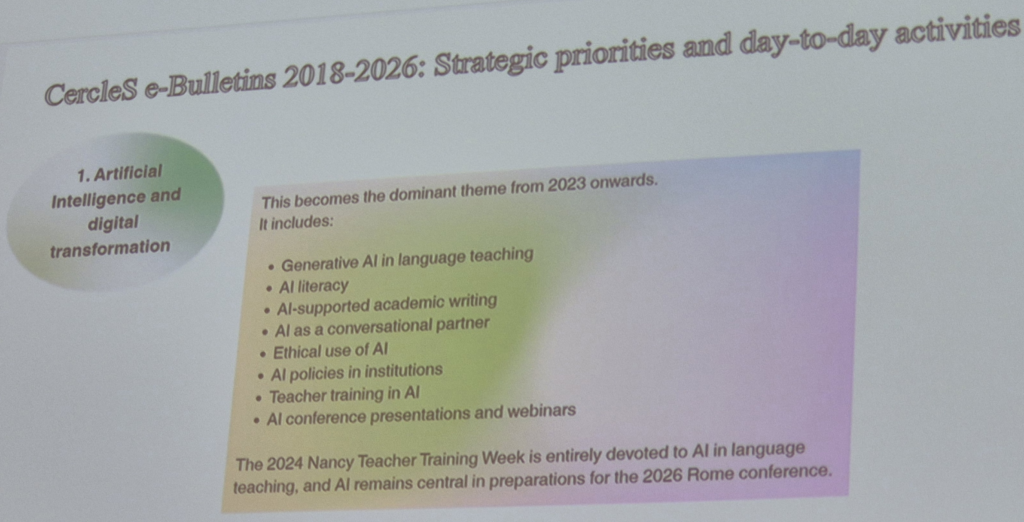
Image 1. AI themes in CercleS e-bulletins 2018–2026 (Argondizzo 2026)
PAIRR as a Curricular Intervention
PAIRR is a curricular intervention developed at the University of California, Davis, in the academic year 2023–2024. It integrates generative AI into the writing process: students write a draft, receive peer and AI feedback, reflect on it and revise. It was piloted in 10 courses with 654 students. Of the 361 post-survey participants, 58% preferred peer plus AI, 36% preferred peer alone and 6% preferred AI alone. (Sperber et al. 2025.)
The current version builds on five steps (Table 1). In Step 1, to develop AI literacy, students reflect on short AI readings the instructor provides; they draft their own AI policy or, in our case, familiarise themselves with the university’s AI policy. In Step 2, they provide and receive peer feedback on early drafts; this step helps keep the human in the loop. In Step 3, students use AI for feedback on their drafts. In Step 4, they compare and reflect on both types of feedback, and start planning how to revise their writing. In Step 5, students revise based on the feedback received and write revision reflections. (University Writing Program at UC Davis 2026.)
| Step 1 | AI policy and readings | The class discusses its AI policy and selected readings about AI. |
| Step 2 | Peer feedback | Students provide and receive peer feedback on an early draft. |
| Step 3 | AI feedback | Students ask an AI tool for feedback on the same draft, using the PAIRR feedback prompt and the assignment criteria. |
| Step 4 | Reflect | Students compare, evaluate and reflect on both types of feedback and plan their revision. |
| Step 5 | Revise | Students revise the draft and write a revision reflection. |
Table 1. PAIRR: five key steps (Adapted from University Writing Program at UC Davis 2026)
In PAIRR, writing a draft and exchanging peer feedback come first; using generative AI for feedback follows. The order foregrounds human response and can help stop AI from interfering with composing. The PAIRR researchers do note that, while the order can be varied, guided assessment of AI feedback is crucial for the process. (Sperber et al. 2025.)
PAIRR now uses a dedicated AI tool, MyEssayFeedback (Gamberg et al. 2026). Our students use Microsoft Copilot, which the LAB and LUT AI policy recommends. They can sign in with their credentials, which ensures the entered data is neither used to train large language models nor shared with third parties (LUT University 2025).
For those of us worried about AI ethics, the PAIRR team’s own position may be reassuring. They note that they, too, have concerns about generative AI. Addressing students, the team explains that the aim is to help “you become a critical, ethical, and informed user of AI.” They also see that, since generative AI has absorbed strategies from writing teachers, it has potential to help students revise their writing. (Gamberg et al. 2026.) We share the team’s critical position but also their view about generative AI’s potential to support revising. We aimed to reflect this attitude in our conference workshop.
PAIRR Workshop Session at the XIX CercleS Conference
Our workshop session had three steps: reading, peer feedback, and AI feedback demonstration (Figure 1).
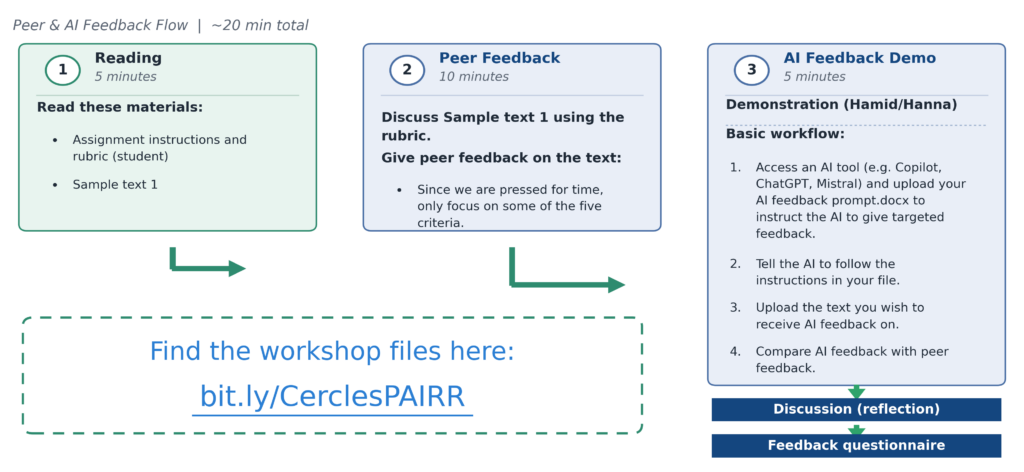
Figure 1. Workshop: Peer & AI Feedback Flow
We first handed the participants a short student-written argumentative essay on conscious food consumption, written for an English for Specific Purposes course by a first-year undergraduate at CEFR B2 (upper-intermediate English). It was used with the student’s permission and had been anonymised. We also provided the participants with the original assignment instructions and an assessment rubric. They read the essay and, acting as if they were the writer’s peers, gave feedback on it (Image 2).
Next, we demonstrated Step 3 of PAIRR and used generative AI for feedback on the essay. Rather than trying it themselves, most participants preferred to watch us do this. We had to use Google Gemini with our personal Google accounts because working on a conference laptop prevented us from signing in to Copilot with our institutional accounts.
To get targeted feedback from a generative AI (Image 3), we had prepared an AI feedback prompt that set the AI’s role, constraints, interaction rules, response structure and tone. It also included the assignment instructions and the rubric. We uploaded the prompt file to Gemini, asked it to follow the instructions in it and then uploaded the essay for its feedback, while running the process live on screen.
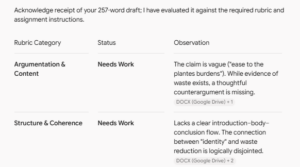
Image 3. AI feedback on the essay
AI-feedback demonstration sparked a lively discussion
Some participants had tried the feedback prompt themselves, on ChatGPT, and noted that its feedback differed from Gemini’s; it was more lenient. We have observed the same: even with the instructions and the rubric in the prompt, generative AIs do not always agree. But this is not that different from two human reviewers giving varied feedback on the same piece.
One participant pointed out that the AI’s feedback sounded too teacherly and was not at her average student’s level. We agreed that the feedback needs to be accessible for the student to act on it. One fix is to adjust the prompt so that the AI gives feedback more as a peer than a teacher.
We also heard that some participants had run similar experiments, though they noted that their prompts had been simpler than ours. This suggests that academic writing teachers are finding ways to deal with generative AI on their own terms, and to integrate it into their pedagogy.
Conclusion
We opened by asking whether academic writing pedagogy will survive generative AI and how it should adapt. We believe mindfully structured curricular interventions, such as PAIRR, offer one answer. Our workshop participants noted that different AI tools give different feedback, and that the register of generative AI feedback may need more focus. Several participants, although new to PAIRR, told us that they had been experimenting with generative AI feedback on their own. For us, PAIRR-like interventions can offer a way to bring generative AI into university writing pedagogy critically and responsibly.
In the spirit of PAIRR, we used generative AI for feedback on draft versions of this article. AI was also used to check referencing mechanics against the LAB citation guidelines. Responsibility for the content remains ours.
References
Argondizzo, C. 2026. CercleS Conferences as Milestones in the Development of a European Community of Practice: A Diachronic Analysis of Evolving Themes and Reflections on Current Societal Expectations. Keynote at the XIX CercleS Conference, Rome, 11 September 2026.
CercleS. 2020. Statuts CercleS / CercleS Statutes (2020). Cited 13 Sep 2026. Available at https://cercles.org/cercles-statutes/
CercleS. 2026. CercleS: European Confederation of Language Centres in Higher Education. Cited 13 Sep 2026. Available at https://cercles.org/
CercleS Conference. 2026. The Role of Language Centres in a Fast-Changing World: Responding to Emerging Needs in Society, Communication, and Learning. Cited 13 Sep 2026. Available at https://www.uniroma4.it/index.php/eventi/cercles-conference-2026/?lang=en
Gamberg, J., MacArthur, M., Mills, A., Sinha, A. & Sperber, L. 2026. AI Is Problematic. Why Does PAIRR Use It? An Ethics Statement for the Peer & AI Review + Reflection Project. University Writing Program at UC Davis. Cited 13 Sep 2026. Available at https://writing.ucdavis.edu/news/ai-problematic-why-does-pairr-use-it
LUT University. 2025. AI-based tools policies. Cited 14 Sep 2026. Available at https://elut.lut.fi/en/completing-studies/rules-and-regulations/ai-based-tools-policies
Sperber, L., MacArthur, M., Minnillo, S., Stillman, N. & Whithaus, C. 2025. Peer and AI Review + Reflection (PAIRR): A human-centered approach to formative assessment. Computers and Composition. Vol. 76, 102921. Cited 13 Sep 2026. Available at https://doi.org/10.1016/j.compcom.2025.102921
University Writing Program at UC Davis. 2026. Peer & AI Review + Reflection (PAIRR). Cited 13 Sep 2026. Available at https://writing.ucdavis.edu/pairr
Authors
Hamid Guedra is a Senior Lecturer in English at the Language Centre of LAB University of Applied Sciences and LUT University. He experiments with AI in ESP/EAP writing pedagogy, specifically AI feedback and learner agency.
Hanna Vihava is a Senior Lecturer in English and Intercultural Communication at the Language Centre of LAB University of Applied Sciences and LUT University. Curiosity and improvisation float her boat.
Illustration: Workshop participants discussing the student essay
How to cite
Guedra, H. & Vihava, H. 2026. Peer and AI Feedback in Academic Writing: A PAIRR Workshop at the XIX CercleS Conference. LAB Pro. Cited and the date of citation. Available at https://www.labopen.fi/lab-pro/peer-and-ai-feedback-in-academic-writing-a-pairr-workshop-at-the-xix-cercles-conference/