LAB Pro

Driven by digitalization, growing sustainability requirements and changing consumer behavior, the textile and clothing industry is undergoing a major transformation. At the same time as traditional business models are being challenged, new opportunities are emerging for innovation, growth and renewal. In this increasingly complex and dynamic operating environment, strategic development has become essential. A well-constructed and flexible strategy helps companies focus on what is truly essential, guiding them towards a future where sustainability, competitiveness, and profitability can coexist.
Authors: Helena Kalliomäki, Mervi Koistinen & Annariina Ruokamo
A strategy provides a company with a clear direction, ensuring that daily decisions and actions support long-term objectives. It is based in the organization’s mission, values and vision: the mission defines its fundamental purpose, values guide ethical and operational choices and the vision outlines its desired future position. A successful strategy answers the four key questions – why, for whom, what and how. It clarifies the company’s purpose and value proposition, identifies its target customers and their needs, defines concrete development priorities, and determines how strategy is implemented through operational practices and everyday actions. (Kalliomäki et al. 2026)
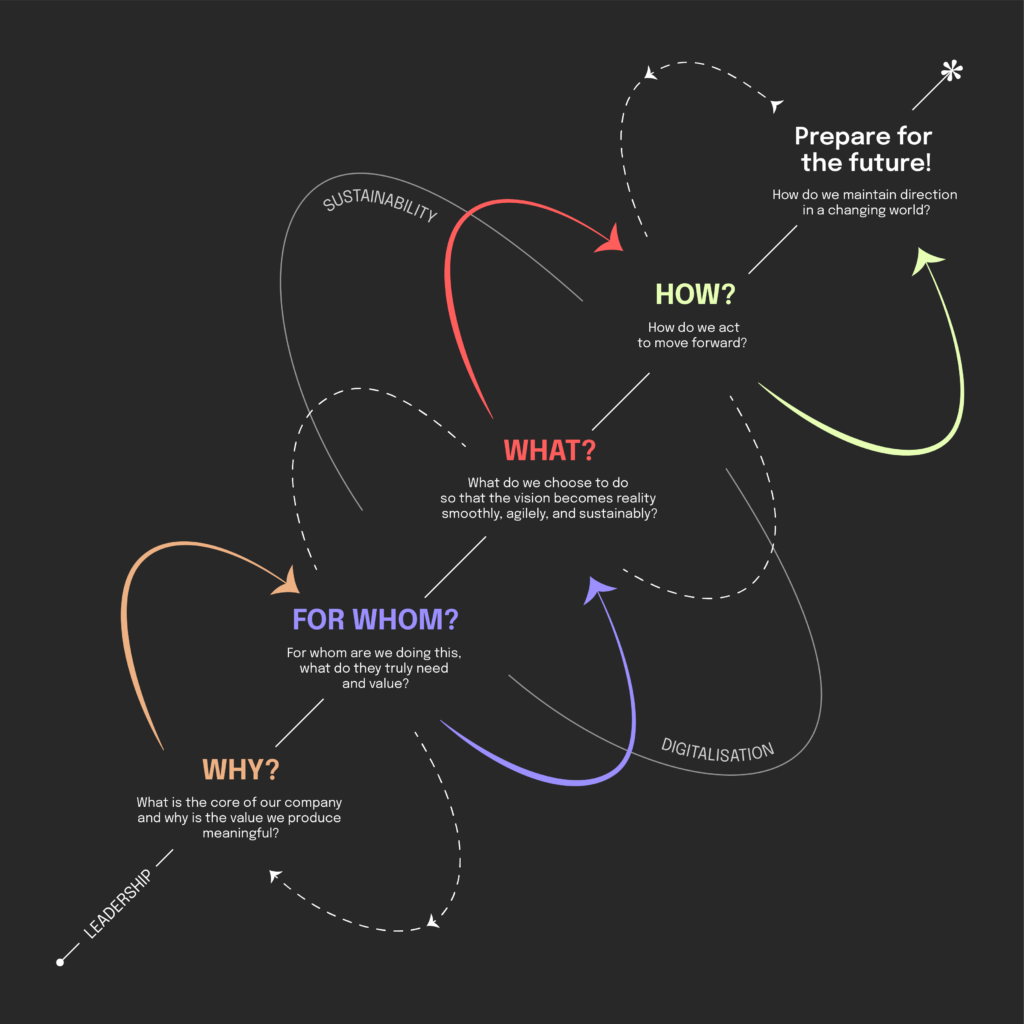
Image 1. A strategic compass for navigating change: beginning with purpose (Why), defining target groups (For whom), setting priorities (What), and determining actions (How) to prepare for the future in an operating environment shaped by digitalisation and sustainability. Leadership serves as a cross-cutting theme, ensuring coherence and alignment throughout the entire strategy process. (Koistinen 2026)
A changing business environment requires a flexible strategy
The contemporary business environment is characterized by rapid technological change, evolving regulatory frameworks, and shifting societal values. As a result, companies must adopt learning-oriented strategies. Competitive advantages that once differentiated companies can quickly become basic expectations, making continuous renewal essential. In the textile and clothing sector, sustainability and digitalization are reshaping the entire value chain. The European Green Deal introduces increasingly strict requirements related to sustainable product design, environmental responsibility, human rights due diligence, and transparent reporting (European Council 2025). While these regulatory changes increase obligations, they also offer significant opportunities to strengthen competitiveness, enhance brand credibility and promote circular economy practices. Sustainability is no longer only about meeting regulatory requirements; it increasingly underpins long-term growth, innovation and resilience.
Digitalization is transforming processes across the entire value chain, from design and production to logistics, marketing and customer engagement. In doing so, it improves efficiency, increases transparency and supports better resource management while enabling stronger collaboration across organizational and geographical boundaries. However, successful digital transformation requires a systematic and context-sensitive approach. There is no universal solution; instead, companies should carefully define which digital solutions best support their strategic goals, customer needs, and operational capacities (Piispanen et al. 2023). Digitalization should not be seen as an end in itself but as a strategic tool for creating sustainable value.
Customer insight as the foundation of strategic development
Customer insight forms the cornerstone of successful strategic development. A deep understanding of customers’ real needs, motivations, expectations, and purchasing behavior enables companies to design products and services that generate genuine value. Quantitative data, such as sales figures, analytics and customer databases, provides an overview of behavioral patterns, while qualitative insights reveal deeper motivations and latent needs that customers themselves may not be consciously aware of (Tuulaniemi 2011).
Information alone does not create value. It becomes meaningful only when actively utilized in decision-making and organizational learning processes (Laihonen et al. 2013). When customer insight is integrated into product development, marketing and customer service, it strengthens organizational coherence and enables more informed decision-making. At the same time, a well-designed customer experience builds loyalty, supports sales and reinforces brand value. (Heikkilä et al. 2022). Moreover, customer expectations increasingly guide sustainability efforts. Transparent communication, responsible sourcing, and services that extend product lifecycles, such as maintenance and repair, enhance trust and reinforce positive brand perceptions. When responsibility and transparency are aligned with customer values, sustainability can become a powerful competitive advantage.
From experimentation to a learning strategy
Strategic development in uncertain environments increasingly relies on experimentation and continuous learning. Instead of rigid, long-term planning, companies benefit from small-scale trials that allow rapid testing, evaluation and adaptation. Digital tools, data utilization and artificial intelligence offer new opportunities for improving operational efficiency, supporting creative work and enhancing customer engagement, particularly when implemented through low-risk pilot projects (Ali-Yrkkö et al. 2023).
Design Thinking and Lean startup principles emphasize iterative development, customer involvement and reflective learning. Concepts are tested in real-life contexts, feedback is collected, and solutions are refined based on empirical evidence (Blank 2013; Brown 2009). Reflection and sharing knowledge play a central role in transforming individual experiences into organizational learning, thereby strengthening adaptability, resilience, and innovation capacity (Business Finland 2023). A learning-oriented strategy encourages openness, collaboration and experimentation, enabling organizations to navigate complexity while continuously refining their strategic direction.
Sustainable growth through digitalization
Digitalization supports sustainable growth when it is embedded within core business operations and aligned with strategic objectives. Digital development often progresses in stages: first establishing basic digital structures, then integrating systems where technology, customer experience and data form a cohesive whole (Piispanen et al. 2023). Sustainable growth emerges from incremental improvements and small, measurable experiments. Testing marketing messages, pricing models, digital channels and customer journeys enables companies to identify effective practices and abandon ineffective ones. Over time, these learning cycles build organizational flexibility and strategic clarity.
Effective leadership is critical in guiding digital transformation. Transparent operating models, clearly defined roles, and open communication ensure alignment between strategic objectives and everyday actions. Strong coordination and shared understanding across organizational levels foster collaboration and long-term commitment to digital development process (Suokas 2024).
From strategy to the future
A flexible and adaptive strategy must be future-oriented. Proactive activities should be an integral part of the strategy process, which aims to identify changes in the operating environment and future development trends including economic, technological, and societal aspects. Proactive foresight enables companies to prepare the new competence and expertise required by change as well as the alternative development paths that need to be considered. It also supports strategic choices that improve risk management and the identification of opportunities (Hellström 2025). Foresight strengthens companies’ resilience and competitiveness in a rapidly changing environment.
References
Ali-Yrkkö, J., Kässi, O., Pajarinen, M. & Rouvinen, P. 2023. Digibarometri 2023: Data, tekoäly ja talouskasvu. Elinkeinoelämän tutkimuslaitos. Helsinki: Elinkeinoelämän keskusliitto EK, Liikenne- ja viestintäministeriö, Business Finland & Sitra. Cited 26.1.2026. Available at https://www.etla.fi/julkaisut/muut-julkaisut/digibarometri-2023-data-tekoaly-ja-talouskasvu/
Blank, S. 2013. Why the Lean Start-Up Changes Everything. Harvard Business Review. Cited 26.1.2026. Available at https://hbr.org/2013/05/why-the-lean-start-up-changes-everything
Brown, T. 2009. Change by Design: How Design Thinking Transforms Organizations and Inspires Innovation. HarperBusiness
Business Finland. 2023. The Digital Finland Framework. Helsinki: Työ- ja elinkeinoministeriö, Business Finland & VTT. Cited 26.1.2026. Available at https://www.businessfinland.fi/globalassets/julkaisut/digital-finland-framework.pdf
European Council 2025. Euroopan vihreän kehityksen ohjelma. Cited 30.1.2026. Available at https://www.consilium.europa.eu/fi/policies/european-green-deal/
Heikkilä, H. Markkanen, P. Mustaniemi, T. Pakarinen, K. Piironen, H. Torkkeli, L. ja J Väisänen, J. 2022. UX-Opus, opas käyttökokemuksen termiviidakkoon. LAB-ammattikorkeakoulun julkaisusarja, osa 55. Lahti. Cited 17.1.2026. Available at https://www.theseus.fi/bitstream/handle/10024/786926/LAB_2022_55.pdf
Hellström, E. 2025. Mietityttääkö talouden suunta? Ota avuksi ennakoinnin työkalut. Artikkeli. Sitran verkkosivut 2025. Cited 28.1.2026. Available at https://www.sitra.fi/artikkelit/mietityttaako-talouden-suunta-ota-avuksi-ennakoinnin-tyokalut/#heading-mkgnmh83ha4
Kalliomäki, H., Koistinen, M., Ruokamo, A. 2026. Muotoile kestävää kasvua! Joustavan strategian tiekartta tekstiili- ja vaatealan yrityksille. LAB-ammattikorkeakoulu. Cited 26.2.2026 Available at https://urn.fi/URN:ISBN:978-951-827-518-6
Koistinen, M. 2026. Strategy wheel. In Muotoile kestävää kasvua! Joustavan strategian tiekartta tekstiili- ja vaatealan yrityksille. LAB-ammattikorkeakoulu. Cited 26.2.2026 Available at https://urn.fi/URN:ISBN:978-951-827-518-6
Laihonen, H., Hannula, M., Helander, N., Ilvonen, I., Jussila, J., Kukko, M., Kärkkäinen, H., Lönnqvist, A., Myllärniemi, J., Pekkola, S., Virtanen, P., Vuori, V. & Yliniemi, T. 2013. Tietojohtaminen. Tampereen teknillinen yliopisto: Tietojohtamisen tutkimuskeskus Novi
Piispanen, M., Rauhala, S. & Kärhä, M. 2023. Digitalisaation vaikutukset muotialaan. Suomen Tekstiili & Muoti ry. Cited 17.1.2026. Available at https://www.stjm.fi/wp-content/uploads/2023/11/STJM_Digi_vaik_muotialaan_taitto_v2.pdf
Suokas, Marjut. 2024. Avaimia potentiaalin vapauttamiseen ja organisaation kasvuun: valmentavan johtamisen osaamisen lisääminen ja hyödyntäminen asiantuntijatyössä. YAMK-opinnäytetyö. LAB-ammattikorkeakoulu. Cited 26.1.2026. Available at https://urn.fi/URN:NBN:fi:amk-2024121636290
Tankilevitch, P. 2020. A Person Opening a Package. Available at: https://www.pexels.com/photo/a-person-opening-a-package-4440908/
Tuulaniemi, J. 2011. Palvelumuotoilu. 4.painos. Helsinki: Talentum.
Authors
Helena Kalliomäki (MA) works as RDI specialist and project manager at LAB University of Applied Sciences, Institute of Design and Fine Arts. She also has extensive work experience as a designer in the textile and clothing industry. Helena is particularly familiar with novel circular solutions that extend product life cycles, as well as the challenges and opportunities associated with them.
Mervi Koistinen (BA) works as RDI expert at LAB University of Applied Sciences. In RDI projects, she is responsible for communication and visual impact, as well as applying Design Thinking to practical implementation. She is studying for a master’s degree, focusing on design and digital media solutions. She is passionate about sustainable development and user-centered design.
Annariina Ruokamo (MA) works as RDI specialist and part-time lecturer at the LAB University of Applied Sciences Institute of Design and Fine Arts. She has previously worked as a clothing designer and sustainability expert. Her current areas of expertise include sustainability in the textile and fashion industry and circular design.
Illustration: Changes in consumer behavior, such as shifts in attitudes toward online shopping, offer new opportunities for developing digital business. Available at https://www.pexels.com/photo/a-person-opening-a-package-4440908/(Polina Tankilevitch, Pexels License)
Reference to this article
Kalliomäki, H. 2026. Shaping flexible and adaptive strategies for a sustainable textile sector. LAB Pro. Cited and date of citation. Available at https://www.labopen.fi/en/lab-pro/shaping-flexible-and-adaptive-strategies-for-a-sustainable-textile-sector/