LAB Pro

Bringing multiple analysis methods to one’s research enables researchers to ob-tain clear, theoretical and actionable results even when the research subject is kept anonymized. For a case study, a successful synthesis follows a process from scenario-based interviews through thematic and content analysis to themed and comprehensive results. Customer Relationship Management (CRM) implementation in service organisations tend to benefit from such experiences.
Authors: Hanna-Henriikka Koponen & Sajal Kabiraj
Practical and theory-relevant results with multi-method approach
It is possible to produce practical and theory-relevant results, even if the case company must remain anonymous. Koponen (2025) combined thematic and content analysis. Thematic analysis was used to showcase patterns from scenario-based interviews and content analysis was used to consolidate and compare the findings. Even the research was a case study, with these methods it was possible to deliver clear contributions to the used frameworks technology acceptance model (TAM) and ISO 9241-210 (2019). The research encourages to use multi-method approach, and this could be beneficial for service organisations which intend to use CRM systems for facilitating continuous improvements.
Thematic analysis shines in discovering patterns from interview content. Content analysis excels in systematic categorization and cross-data consolidation. (Hsieh & Shannon 2005; Naeem et al. 2023.) In an anonymized case study, combining these support in-depth and contextual data to be combined with clear and categorizable data without revealing sensitive information.
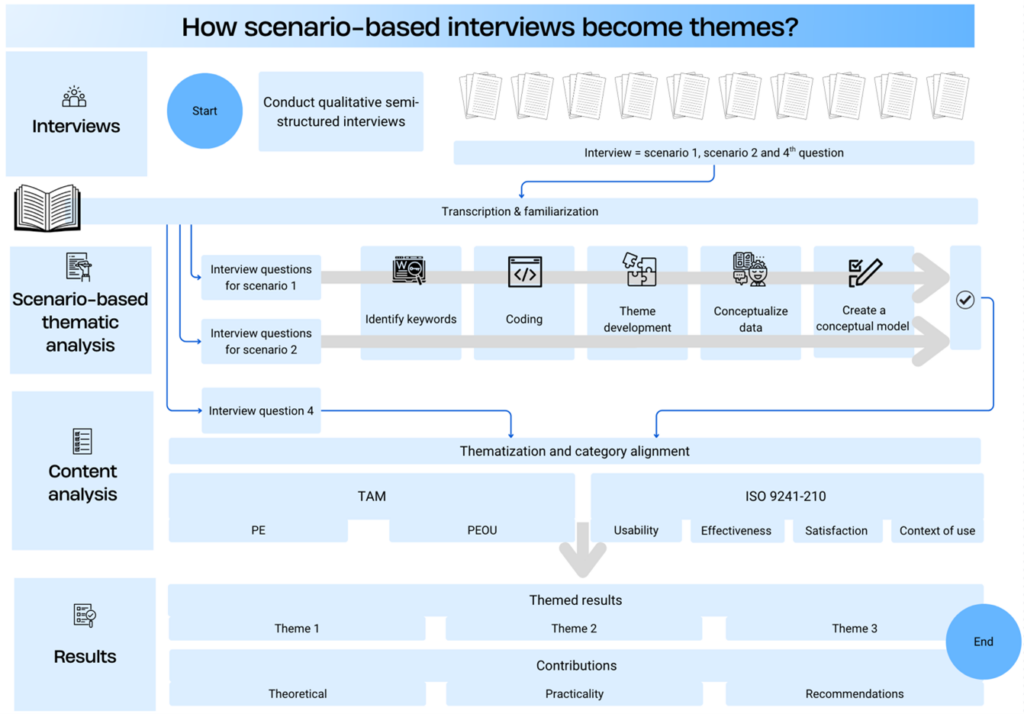
Image 1. Analysis flowchart: how the interview context is analyzed through thematic and content analysis to results of themes. (Koponen 2025)
Scenario-based thematic analysis
The data was gathered with ten semi-structured interviews, which focused on two of the most common customer service scenarios (handling address change via phone and email). Thematic analysis follows a six-step process: transcribing (and in this case anonymizing) the interviews, keyword identification, coding, theme development, conceptualizing and conceptual modelling (Naeem et al. 2023). In the research the findings through this process were automation and centralized data enhancing user´s speed and accuracy, usability issues appeared in naviga-tion and exception handling. These findings distinctly fit to the perceived usefulness (PU) of TAM through speed and accuracy and to the perceived ease of use (PEOU) of TAM through navigability. In addition, findings indicated design challenges framed in ISO 9241-210 principles of usability, effectiveness, satisfaction and context of use.
Content analysis across scenarios
The two scenario-based thematic results were consolidated with a content analysis, where thematization aligned with categories identified with PU, PEOU and ISO. This produced themes (such as usability and task efficiency, ease of use and navigation, usability challenges and support needs) and raised anonymized, but evidence-based actionable insights for both scenarios researched without disclosing identifying details. An additional non-scenario-based interview question was analyzed separately with a content analysis. Interview questions focused on im-provement ideas. Content analysis created a cluster of ideas (such as simplifying address change, enhancing identification across channels, reducing manual work in case management and creating workflow to exception handling). These user-generated ideas strengthened the earlier constructed themes in PU, PEOU and ISO and offered practical recommendations.
Delivered themes and recommendations
The thematic and content analysis concluded to three coherent themes:
- Process efficiency and automation, highlighting streamlined workflows and minimizing manual work.
- Usability and ease of use, simplifying navigation and exception handling.
- Workflow flexibility and case management, ensuring true context of use and quality of usefulness in real-world use cases.
Recommendations included practical tasks to move forward with as well as new and enhanced processes to maintain human-centred-design (HCD), which support PU and PEOU and align with ISO 9241-210 (Talukder 2014).
The chosen two methods complement each other, while enabling the study to be conducted with rigor, confidentiality and enthusiasm. Thematic analysis ensures context and nuances, content analysis holds comparability and clarity for the theoretical linkage. This enables the results to be actionable, replicable, publishable while under anonymity constraints. For organizations to receive in-depth insights supports agile decision-making and enables continuous development processes to be improved in everyday tasks as well as strategic goal setting. Service organisations tend to gather actionable insights which could be used for futures analysis and foresights for strategic decision-making.
Conclusion
Digital solutions and automation through CRM help companies in accelerating the pace of transformation and innovating solutions to understand the customer better. It creates an enhanced user experience for fostering better relationships with customers in the long-term. Centralization of data is beneficial for the companies to fetch data with a consolidated one-view of the customer’s interaction and touch points with the company. CRM systems help in optimizing service quality leading to integration and faster processing of work and delivery of results. User experience and customer satisfaction is enhanced through implementation and adoption of CRM systems. It helps in building customer loyalty and trust among stakeholders and partners. Service companies implementing CRM systems benefit through increased co-operation through lean processes and value-addition through faster speed of delivery.
References
Hsieh, H-F. & Shannon, S. E. 2005. Three approaches to qualitative content analysis. Sage Publications: Qualitative Health Research. Vol.15 (9), 1277–1288. Cited 1 December 2025. Available at https://doi.org/10.1177/1049732305276687
ISO 9241-210. 2019. Ergonomics of human-system interaction – Part 210: Human-centred design for interactive systems. Genéva: The international Organization for Standardization.
Koponen, H-H. 2025. CRM System Adoption in Customer Service: Case: Company X. Master’s thesis. LAB University of Applied Sciences. Cited 1 December 2025. Available at https://urn.fi/URN:NBN:fi:amk-2025120833733
Naeem, M., Ozuem, W., Howell, K. & Ranfagni, S. 2023. A Step-by-Step Process of Thematic Analysis to Develop a Conceptual Model in Qualitative Research. International Journal of Qualitative Methods. Vol.22. Cited 1 December 2025. Available at https://doi.org/10.1177/16094069231205789
Talukder, M. 2014. Managing innovation adoption. From Innovation to Implementation. London: Gower. Cited 1 December 2025. Available at https://doi.org/10.4324/9781315593609
Authors
Hanna-Henriikka Koponen studies Business Innovation Culture and Creativity (MBA) at the Faculty of Business Administration at LAB University of Applied Sciences, Lappeenranta.
Sajal Kabiraj, PhD, Principal lecturer, Faculty of Business and Hospitality Management, LAB University of Applied Sciences, Lahti.
Illustration: https://pxhere.com/fi/photo/1153017 (CC0)
Reference to this article
Koponen, H.-H. & Kabiraj, S. 2026. From interviews to insight: combining thematic and content analysis in an anonymized CRM case study. LAB Pro. Cited and date of citation. Available at https://www.labopen.fi/lab-pro/from-interviews-to-insight-combining-thematic-and-content-analysis-in-an-anonymized-crm-case-study/