LAB Pro

In the dynamic world of high-tech innovation, organizations constantly grapple with the tension between exploration and exploitation. This article explores how these inherent tensions can be harnessed to drive innovation by investigating the experiences of innovation creators in a Finnish high-tech company. It highlights how individual paradox mindsets and organizational enabling conditions can transform tensions into catalysts for innovation.
Authors: Kristiina Brusila-Meltovaara & Mika Päivänsara
The Complexity of Innovation
Innovation is the key to gaining a competitive advantage and maintaining market positions. It is also more than breakthrough products. Innovation is systemic and uncertain at its core, and does not follow a linear development process (Fragkandreas 2025). It is shaped by feedback loops, coevolution, and continuous interplay between stability and chaos (Poutanen et al. 2016). Innovation involves individuals and stakeholders whose diverse competencies and qualities weave together in unexpected and contradictory ways, forming a complex, future-creating social process (Kline & Rosenberg 2009; Veloudis et al. 2025). Innovative leadership includes ethical behavior, openness to new ideas, appreciation of diversity, and creating psychological safety. Leaders inspire, support learning, and encourage risk-taking to drive innovation. (Brusila-Meltovaara et al. 2025; Brusila-Meltovaara et al. 2024). Innovation derives from combining resources and creative thinking. Leadership directly influences the innovation culture of an organization: an innovative leader creates a vision, promotes continuous learning, and encourages collaboration. Organizations that invest in innovation capabilities and cultivate leaders with innovative traits are better positioned to thrive in dynamic markets. (Brusila-Meltovaara et al. 2025; Johnson & Hackman 2018.)
As environments become more complex and competitive, organizations face increasing pressure to balance exploration and exploitation strategies (Kassotaki 2022). Explorative behaviour manifests as searching for broader knowledge, identifying opportunities, experimenting, and embracing novelty. Exploitative behaviour deepens existing knowledge, creates incremental improvements, and focuses on efficiency. These behaviours are contradictory: exploration requires creative, open-ended thinking, while exploitation depends on sustained, concentrated focus. Yet both are intertwined and cannot be separated from each other. Balancing both increases agility and flexibility to adapt to a rapidly changing environment. (Shaalan et al. 2023; Yang et al. 2025.) Innovation creators, such as designers, engineers, and project managers in R&D teams, must shift between explorative and exploitative behaviours spontaneously, often within the same project or even the same day.
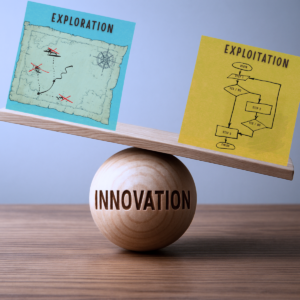
Kuva 1: Balancing E&E. (Kuva: Mika Päivänsara, kuvan luonnissa käytetty Gemini 3.1 Pro:ta ja Canvaa)
From contradictions to defensive responses
The need to balance exploration and exploitation leads to contradicting requirements, opposing demands and incompatibilities. When encountered by employees, they experience a pull between the opposites, manifesting as stress, anxiety and even paralysis. (Putnam et al. 2016.) The resulting psychological tension may overwhelm individuals and, combined with performance pressures, overload cognition. It can also shift intrinsic motivation to external demands, often at the cost of novelty and creativity (Miron-Spektor et al. 2022; Jang & Kim 2025).
When tensions trigger defensive responses, characterized by denial or avoidance, conflicting demands are framed as threats to be eliminated. This often leads to either/or decisions and blame-shifting rather than transformative change. (Luo et al. 2020.) If the interdependent contradictions are not managed systematically, their dynamics can become self-reinforcing and gradually harden into a vicious cycle. This can constrain future choices as the organization becomes path-dependent on defensive simplifications rather than adaptive balancing responses. (Autioniemi 2025.)
In the studied Finnish high-tech R&D organization, innovation creators reported both a strong need to balance opposing demands and a strong effort to do so. Some viewed these tensions as opportunities, but most described them as straining “idea killers” causing frustration. Increasing pressure from structural constraints, in the form of scarce resources and efficiency requirements, triggered defensive behaviours: avoiding complexity by unjustified simplification, doing as told despite doubts, compromising quality, and reusing old designs. (Päivänsara 2025.)
Tensions enabling innovation
Rather than treating tensions between exploration and exploitation as problems to solve once and for all, individuals can accept persistent contradictions, balance between them, and discover opportunities within the tension itself. This paradox mindset enables employees to view complex and uncertain circumstances as possibilities for progress through learning and growth. People with a stronger paradox mindset are more comfortable holding tensions, better able to shift between behaviours required to achieve competing goals, and more capable of interpreting complex organizational dynamics. (Wiewiora 2023; Khan et al. 2025.) A paradox mindset supports both the differentiating behaviour of exploration and the integrating behaviour of exploitation (Van Assen & Caniëls 2022).
In the studied organization, higher paradox mindset tendencies significantly predicted the perception of positive innovation outcomes, increased empowerment, and stronger leadership support, while lower paradox mindset tendencies predicted hindrance in these same areas. Those with higher paradox mindset tendencies also described contradictions more often as interesting design problems rather than dead ends. They spoke about co-creation, open discussion, and joint problem-solving, and gave examples in which outrageously opposing requirements led to innovative solutions. In other words, the core issue is often not that tensions exist, but how they are worked with. (Päivänsara 2025.)
Influence from the paradox mindset does not emerge in isolation. The capability sparks in the presence of favorable team climate, supportive leadership, and an enabling organizational culture (Nguyen & Nguyen 2025). The research in the R&D organization revealed intertwined enabling conditions that together determine whether tensions become catalysts for innovation or sources of frustration.
Trust and psychological safety form the foundation: when trust exists, tensions become addressable challenges that spark creative problem-solving. Shared vision alignment is critical for navigating contradictory demands, as autonomous choices then align toward common goals. Adaptive leadership helps balance the freedom to explore with the structure needed to exploit, often by holding contradictions simultaneously. Together with paradox mindset, these elements form a mutually reinforcing system. When these elements are in balance, tensions can be embraced as a way to navigate organizational complexity. In the studied organization, this enabled more efficient resource allocation between exploration and exploitation, supporting both novelty and usefulness. When the system was out of balance, the same tensions extinguished the creative flame and led to confusion and wasted resources. (Päivänsara 2025.) Understanding and nurturing psychological safety and trust and understanding tensions and the paradox mindset enables organizations to further form a basis for enhancing organizational innovation capabilities.
References
Autioniemi, J. 2025. Paradoksaalinen kompleksisuusteoria: Paradoksien johtaminen kompleksisissa järjestelmissä. Hallinnon Tutkimus,. Vol. 44(4). Cited 16 Jan 2026. Available at https://journal.fi/hallinnontutkimus/article/view/161517
Brusila-Meltovaara, K., Lampropoulos, G., Makkonen, P. and Siakas, K., 2025, September. Traits of Innovative Leadership. Academic conferences international. Cited 23 Jan 2026. Available at https://urn.fi/URN:NBN:fi-fe2024100476090
Brusila-Meltovaara, K., Makkonen, P., Siakas, K. and Lampropoulos, G., 2024, September. Open Innovation Capabilities and Competences. In 19th European Conference on Innovation and Entrepreneurship. Universidade Portucalense. Cited 22 of Jan 2026. Available at https://osuva.uwasa.fi/server/api/core/bitstreams/c4c13d1d-6851-4b11-8e6a-cb73029a772e/content
Fragkandreas, T. 2025. Case study research on innovation systems: Paradox, dialectical analysis and resolution. Research Policy. Vol. 54 (1), 105136. Cited 15 of Jan 2026. Available at https://doi.org/10.1016/j.respol.2024.105136
Jang, E. & Kim, Y.C. 2025. Autonomy Constrained: The Dynamic Interplay Among Job Autonomy, Work Engagement, and Innovative Behavior Under Performance Pressure. Administrative Sciences. Vol. 15 (3), 97. Cited 15 of Jan 2026. Available at https://doi.org/10.3390/admsci15030097
Johnson, C. E., & Hackman, M. Z. 2018. Leadership: A communication perspective. Waveland Press.
Kassotaki, O. 2022. Review of Organizational Ambidexterity Research. Sage Open. Vol. 12 (1), 21582440221082127. Cited 15 of Jan 2026. Available at https://doi.org/10.1177/21582440221082127
Khan, M.T., Ullah, S., Sami, A., Kukreti, M. & Shaukat, M.R. 2025. Cultivating a paradoxical mindset: enhancing transformative learning through paradoxical leadership. Leadership & Organization Development Journal. Vol. 46 (2), 334–350. Cited 15 of Jan 2026. Available at https://doi.org/10.1108/LODJ-04-2024-0223
Kline, S.J. & Rosenberg, N. 2009. An Overview of Innovation. Studies on Science and the Innovation Process. 173–203. Cited 15 of Jan 2026. Available at https://doi.org/10.1142/9789814273596_0009
Luo, B.N., Tang, Y., Chen, E.W., Li, S. & Luo, D. 2020. Corporate Sustainability Paradox Management: A Systematic Review and Future Agenda. Frontiers in Psychology. Vol. 11, 579272. Cited 15 of Jan 2026. Available at https://doi.org/10.3389/fpsyg.2020.579272
Miron-Spektor, E., Emich, K.J., Argote, L. & Smith, W.K. 2022. Conceiving opposites together: Cultivating paradoxical frames and epistemic motivation fosters team creativity. Organizational Behavior and Human Decision Processes. Vol. 171, 104153. Cited 15 of Jan 2026. Available at https://doi.org/10.1016/j.obhdp.2022.104153
Nguyen, C. and Nguyen, D., 2025. Navigating Contradictions for Organizational Agility: A Systematic Literature Review on the Paradox Mindset in the Workplace. International Journal of Entrepreneurship & Technopreneur (INJETECH). Vol. 5(1), 51-63. Cited 15 of Jan 2026. Available at https://ojs.unikom.ac.id/index.php/injetech/article/view/16636
Poutanen, P., Soliman, W. & Ståhle, P. 2016. The complexity of innovation: an assessment and review of the complexity perspective. European Journal of Innovation Management. Vol. 19 (2), 189–213. Cited 15 of Jan 2026. Available at https://doi.org/10.1108/EJIM-03-2014-0036
Putnam, L.L., Fairhurst, G.T. & Banghart, S. 2016. Contradictions, Dialectics, and Paradoxes in Organizations: A Constitutive Approach. Academy of Management Annals. Vol. 10 (1), 65–171. Cited 15 of Jan 2026. Available at https://doi.org/10.5465/19416520.2016.1162421
Shaalan, L.A.A.B., Elsaid, A.M., Professor of Human Resource Management, Faculty of Commerce, Ain Shams University, Egypt, Aboul-Ela, G.M.B.E., & Professor of Human Resource Management, Faculty of Commerce and Business, Administration, Future University in Egypt (FUE), Egypt 2023. An overview on employee innovation behavior. The Business and Management Review. Vol. 14 (02). Cited 15 of Jan 2026. Available at https://doi.org/10.24052/bmr/v14nu02/art-17
Van Assen, M.F. & Caniëls, M.C.J. 2022. Economic and social LMX and innovative work behaviour: the moderating effect of paradox mindset. European Journal of Innovation Management. Vol. 25 (6), 1057–1075. Cited 15 of Jan 2026. Available at https://doi.org/10.1108/EJIM-05-2022-0234
Veloudis, S., Ryan, M., Ketikidi, E. & Blok, V. 2025. Responsible innovation in start-ups: entrepreneurial perspectives and formalisation of social responsibility. Journal of Responsible Innovation. Vol. 12(1), 2453251. Cited 15 of Jan 2026. Available at https://doi.org/10.1080/23299460.2025.2453251
Wiewiora, A. 2023. Identifying and managing persisting tensions affecting strategic learning from projects. Long Range Planning. Vol. 56(1), 102267. Cited 15 of Jan 2026. Available at https://doi.org/10.1016/j.lrp.2022.102267
Yang, M., Yang, J. & Torres De Oliveira, R. 2025. How do ambidextrous capabilities promote disruptive innovation in emerging markets, from the lens of knowledge-based view? Journal of Knowledge Management. Vol. 29(5), 1730–1752. Cited 15 of Jan 2026. Available at https://doi.org/10.1108/JKM-06-2024-0716
Authors
Kristiina Brusila‑Meltovaara is a Principal Lecturer in the Technology Unit with a strong interest in leadership research.
Mika Päivänsara is an R&D Project Manager and leadership coach focused on organisational development and innovation.
Illustration: https://pxhere.com/en/photo/1379760 (CC0)
Reference to this article
Brusila‑Meltovaara, K. & Päivänsara, M. 2026. Do you see what I see? Navigating Paradox – Transforming Organizational Tensions into Innovation. LAB Pro. Cited and date of citation. Available at https://www.labopen.fi/en/lab-pro/do-you-see-what-i-see-navigating-paradox-transforming-organizational-tensions-into-innovation/