LAB Pro
Europe is distancing itself from American digital platforms. Alongside this shift, there is an opportunity to develop European software according to Industry 5.0 principles—human-centricity, sustainability, resilience. But such principles remain abstract without criteria that make them binding. This article focuses on the meso level: procurement, governance, and accountability structures where design decisions take effect.
Author: Harri Heikkilä
France signals a shift
In January 2026, the French government announced that all state agencies would replace Microsoft Teams, Zoom, and other non-European videoconferencing platforms with European alternatives by 2027. Minister David Amiel, responsible for civil service and state reform, justified the decision by the aim to “end the use of non-European solutions and guarantee the security and confidentiality of public electronic communications” (Euronews 2026). The decision reflects growing concern over data sovereignty and dependence on foreign infrastructure. France is not alone. Over 80 per cent of Europe’s digital infrastructure relies on non-EU countries for digital products, services, infrastructure and intellectual property (European Parliament 2025). This is no longer a technical detail but a strategic constraint. The shift in US administration in early 2025, and its increasingly adversarial posture toward European security and digital regulation, has added geopolitical urgency to what was previously framed as a technical concern. The French announcement signals that decoupling has moved from debate to implementation.
Digital sovereignty is important, but it is about origin, security, and cost. It says nothing about design. The European Parliament (2025) report on technological sovereignty warns of another risk: if each member state builds its own siloed solution, the result may be European independence without European interoperability.
Technology is not neutral
Design and origin matter because platforms are far from neutral tools. They embed values: assumptions about how work should flow, how decisions should be made, and who is expected to take responsibility—what Langdon Winner (1986) called the politics of artifacts. American enterprise platforms typically optimise for engagement, growth, and seamless integration—values that serve scalability and shareholder returns. A European organisation adopting such a platform inherits not only the software but a particular account of coordination, hierarchy, and efficiency.
Replacing an American platform with a European one does not automatically change this. If the replacement is designed according to the same logic, the assumptions remain. Only the flag on the server changes. The opportunity lies in designing according to different priorities: data security as a default rather than an add-on, transparency in how systems process information and make recommendations, and sustainability understood not only environmentally but cognitively—technology that preserves rather than depletes human attention and judgement.
This is where Industry 5.0—the European Commission’s vision for the next phase of industrial development—could be invoked. The Commission frames it around sustainability, resilience, and human-centricity (European Commission 2021). But these remain abstractions without criteria that translate them into procurement requirements. What would a transparent AI diagnostic system look like? What does cognitive sustainability mean for a coding.
The meso level: where criteria become binding
Much discussion of human-centric technology focuses on interfaces and usability. These concerns matter, but they address symptoms rather than causes. The decisive choices happen earlier, in procurement—the criteria by which organisations select and purchase systems—governance models, and the question of what a system is designed to optimise. This is the meso level, between policy frameworks and individual user experience. Europe’s opportunity lies here: not merely to replace American platforms with European ones, but to build technology according to different principles. Arnstein’s (1969) ladder of citizen participation offers a useful frame: it distinguishes tokenistic participation (informing, consultation) from genuine citizen power (partnership, delegated power, citizen control). The sovereignty discourse focuses on who owns the system but overlooks the question: at which rung of the ladder is the user positioned? A European platform that keeps users at the level of “informing” is no more human-centric than its American counterpart. If Europe wants technology that reflects its stated values, the question is not only where systems are built, but how they are designed—and for whom.
Consider a hospital choosing between two AI diagnostic systems. One prioritises throughput, processing more cases per hour and flagging deviations from statistical norms. The other preserves clinical judgement, presenting information without recommendations and leaving interpretation to physicians. Both can be marketed as human-centric. The difference lies in what each system assumes about the professional using it. This is not a technical detail. It is a design decision—and one that European procurement could make explicit. But making it explicit is not enough. Research on participatory public service development shows that user involvement easily remains tokenistic unless decision-making responsibility is institutionally anchored (Putto 2022). Good intentions do not suffice; what is needed are binding criteria.
AI-assisted coding as a test case
AI-assisted coding raises the stakes further. Systems such as Cursor and Lovable support vibe-based coding: the platform proposes complete solutions, the user validates and adjusts. Programming shifts from writing code to evaluating generated output. Accountability becomes asymmetric—the system generates, the human remains responsible.
But the deeper change is who can now produce software. When building an application requires describing intent rather than writing code, development spreads beyond professional developers. The fragmentation risk noted earlier reappears at the level of organisations and teams: more sites where design decisions are made, each embedding different assumptions about users and quality.
Productivity metrics—speed, output, error rates—do not address this. They measure efficiency, not design. They say nothing about what a tool assumes about the people who will use it, or whether sustained use develops or erodes their competence.
Toward operational criteria
These questions do not guarantee good outcomes. They make trade-offs visible. But asking them requires competence that most purchasing organisations lack. Buying software is not like buying furniture. It demands the ability to evaluate design decisions—what a system assumes, what it optimises, what it makes difficult. Industry 5.0 frames human-centricity as a European priority, but the framework remains still abstract. If it is to mean anything in practice, it must translate into requirements that those who purchase technology can recognise, demand, and verify. Design literacy is not a luxury for specialists. It is a precondition for procurement that takes human-centricity seriously.
References
Arnstein, S. R. 1969. A Ladder of Citizen Participation. Journal of the American Institute of Planners. 35 (4), 216–224. Cited 1 Feb 2026. Available at https://doi.org/10.1080/01944366908977225
Euronews. 2026. France to ditch US platforms Microsoft Teams, Zoom for ‘sovereign platform’ citing security concerns. 27 January 2026. Cited 1 Feb 2026. Available at https://www.euronews.com/next/2026/01/27/france-to-ditch-us-platforms-microsoft-teams-zoom-for-sovereign-platform-amid-security-con
European Commission. 2021. Industry 5.0: Towards a Sustainable, Human-Centric and Resilient European Industry. Directorate-General for Research and Innovation. Luxembourg: Publications Office of the European Union. Cited 1 Feb 2026. Available at https://doi.org/10.2777/308407
European Parliament. 2025. Report on European Technological Sovereignty and Digital Infrastructure. A10-0107/2025. Cited 1 Feb 2026. Available at https://www.europarl.europa.eu/doceo/document/A-10-2025-0107_EN.html
Putto, T. 2022. Kyllä kansa tietää – annetaan kansan kertoa! Kansalaisten osallistaminen julkishallinnon digitaalisten palveluiden kehittämisessä. Master’s thesis. LAB University of Applied Sciences. Cited 2 Feb 2026. Available at https://urn.fi/URN:NBN:fi:amk-2022121730694
Winner, L. 1986. The Whale and the Reactor: A Search for Limits in an Age of High Technology. Chicago: University of Chicago Press.
Author
Harri Heikkilä works as a digital technology expert in SOLA-project, promoting growth and new skills in creative sectors. He is a principal lecturer at LAB University of Applied Arts Institute of Design and Fine Arts, and understands that we need better-designed digital systems.
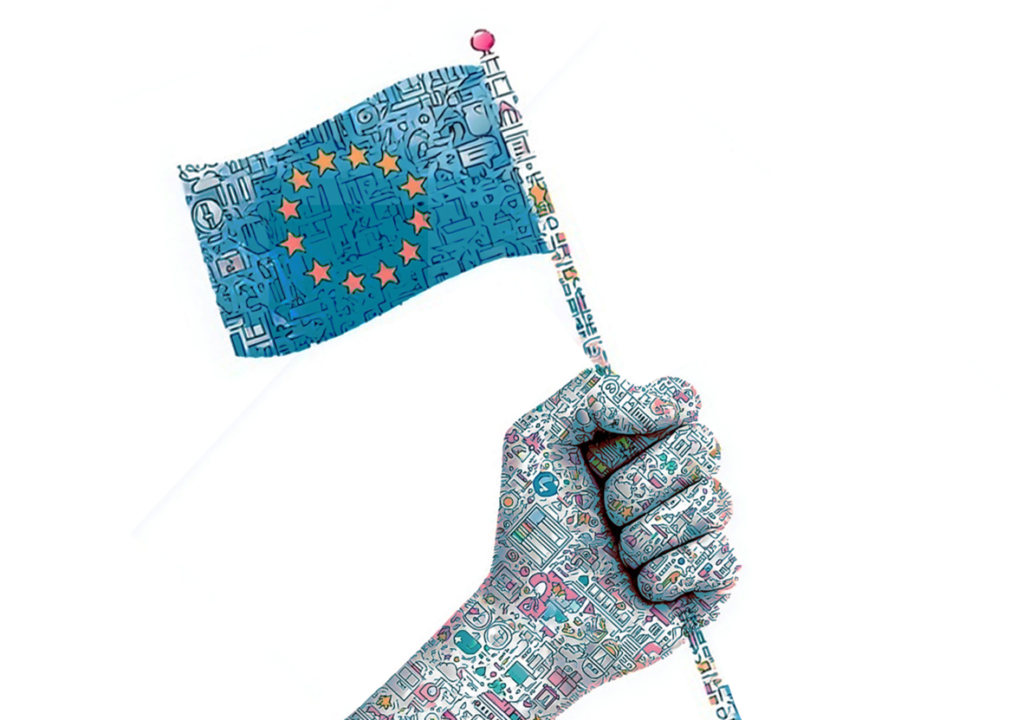
Illustration: Midjourney / Harri Heikkilä
Reference to this article
Heikkilä, H. 2026. Decoupling Is Not Enough: Designing New European Digital Technology. LAB Pro. Cited and date of citation. Available at https://www.labopen.fi/lab-pro/decoupling-is-not-enough-designing-new-european-digital-technology/